How to Start an Agribusiness: A Practical Guide for Entrepreneurs
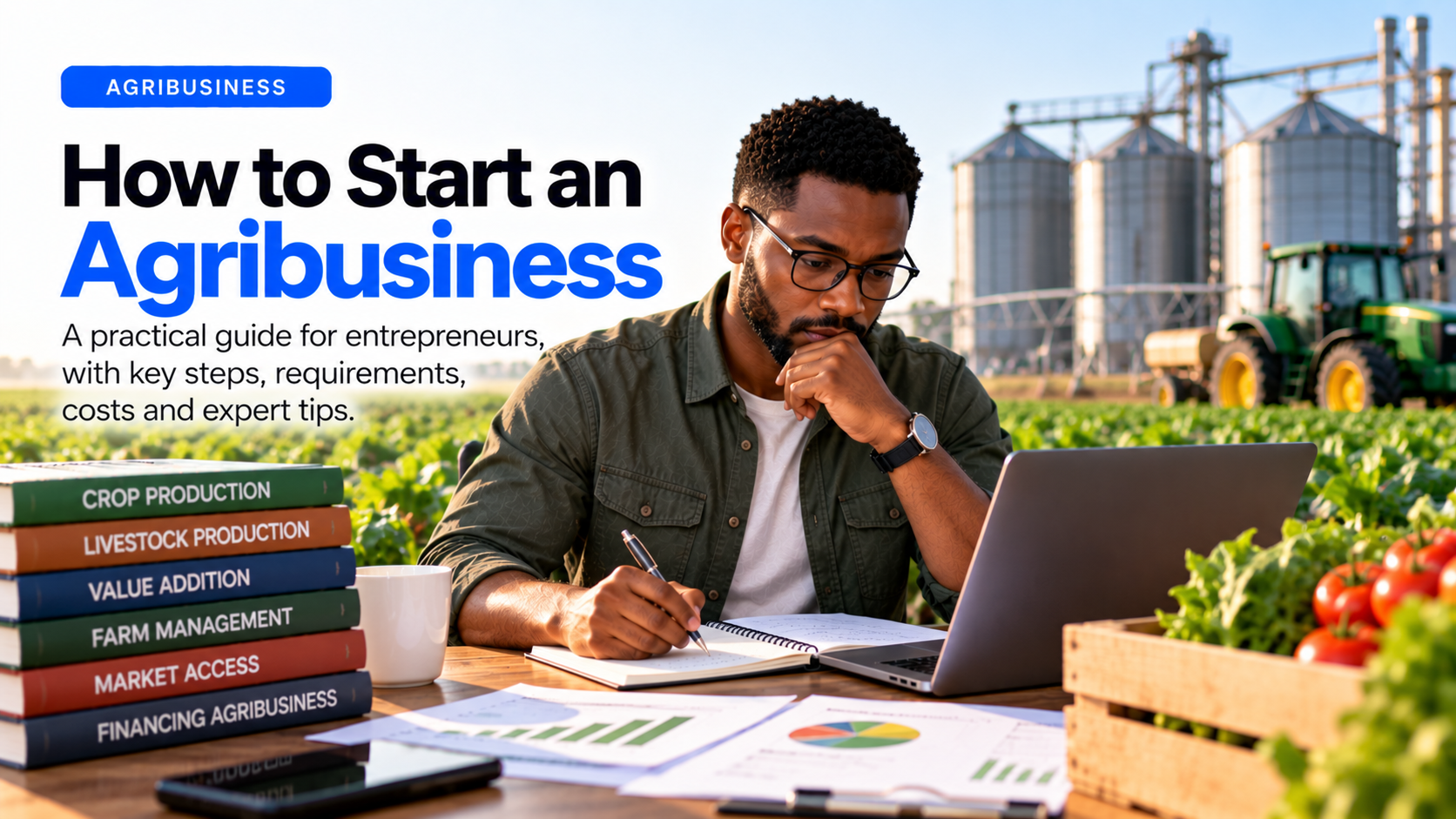
Agriculture is one of the world's biggest economic opportunities.
But agriculture is not automatically a profitable business.
A farmer can produce an excellent crop and still lose money because of poor pricing, high production costs, post-harvest losses, weak distribution, or lack of reliable buyers.
That is why the most important shift for an agricultural entrepreneur is to stop thinking only about farming and start thinking about agribusiness.
Agribusiness is about creating value and making money across the agricultural value chain—not simply producing crops or raising animals.
This guide explains how to identify, evaluate and build an agribusiness that has a realistic path to profitability.
What Is Agribusiness?
Agribusiness includes the businesses involved in producing, processing, distributing and selling agricultural products and services.
This can include:
Crop production
Livestock
Poultry
Fisheries
Agricultural inputs
Farm machinery
Produce aggregation
Storage
Transportation
Processing
Packaging
Distribution
Agricultural technology
Farm services
For example, consider rice.
An entrepreneur could make money from:
Seed → Farming → Aggregation → Milling → Packaging → Distribution → Retail
There are opportunities at multiple stages.
This is why you don't necessarily need to become a farmer to build an agricultural business.
Farming Is Not the Same as Agribusiness
This distinction is important.
Farming
The primary activity is producing agricultural commodities.
Examples:
Growing maize
Growing rice
Raising poultry
Producing eggs
Rearing cattle
Fish farming
Agribusiness
The business can operate anywhere along the value chain.
Examples:
Selling farm inputs
Providing irrigation services
Buying produce from farmers
Processing agricultural commodities
Manufacturing animal feed
Providing cold storage
Packaging agricultural products
Distributing food products
A person who understands markets and logistics but doesn't want to farm may still build a successful agribusiness.
Step 1: Choose the Right Agricultural Opportunity
Don't begin with:
"I want to go into agriculture."
Agriculture is too broad.
Define the specific opportunity.
For example:
Tomato farming
Rice processing
Poultry feed production
Fish farming
Grain aggregation
Cold storage
Livestock fattening
Fruit processing
Agricultural input distribution
Then ask:
Why this opportunity?
Consider:
Market demand
Available resources
Capital requirements
Your expertise
Location
Climate
Infrastructure
Availability of inputs
Access to customers
Expected margins
Step 2: Start With the Market, Not the Farm
One of the biggest mistakes agricultural entrepreneurs make is producing first and searching for customers later.
The better approach is:
Identify the market → understand the buyer → determine specifications → plan production.
Before planting or investing, ask:
Who will buy the product?
How much do they purchase?
How frequently?
What quality do they require?
What price do they pay?
Where are they located?
Who currently supplies them?
Potential buyers might include:
Wholesalers
Processors
Retailers
Restaurants
Hotels
Food manufacturers
Exporters
Government institutions
Schools
Consumers
A confirmed buyer can be more valuable than a large farm.
Step 3: Understand the Agricultural Value Chain
Study where money is created between the farm and the final consumer.
For example:
Farmer → Aggregator → Processor → Distributor → Retailer → Consumer
At each stage, someone adds value.
The question for an entrepreneur is:
Where can I participate profitably?
You may discover that farming itself has thin margins while processing or distribution offers better economics.
For example, instead of growing tomatoes, you might build a business that:
Aggregates tomatoes from farmers
Sorts them
Stores them
Processes them
Packages them
Sells the finished product
The best opportunity isn't always at the beginning of the value chain.
Step 4: Evaluate Your Location
Agriculture is highly location-dependent.
Consider:
Soil
Is the soil suitable for the crop?
Water
Is reliable water available?
Climate
Is rainfall or temperature suitable?
Roads
Can inputs and produce move efficiently?
Electricity
Will you need alternative power?
Markets
How close are your customers?
Labour
Can you find the people you need?
Storage
Can you safely store your output?
Security
Can the operation be protected?
A piece of cheap land can become expensive if transportation, irrigation and infrastructure costs are excessive.
Step 5: Calculate Production Economics
Don't ask only:
"How much can one hectare produce?"
Ask:
"How much does it cost to produce, and how much can I realistically earn?"
For a crop business, calculate:
Land preparation
Seeds
Fertiliser
Chemicals
Irrigation
Labour
Machinery
Transportation
Harvesting
Packaging
Storage
Land costs
Financing costs
Then estimate:
Expected yield × realistic selling price = potential revenue
From this, deduct your total costs.
Be Conservative With Yield Estimates
Agricultural projections often become unrealistic because entrepreneurs use ideal production figures.
For example:
If a crop can theoretically produce 5 tonnes per hectare, don't automatically build your business plan around achieving 5 tonnes.
Consider:
Weather
Pests
Disease
Irrigation
Soil conditions
Farming practices
Post-harvest losses
Farmer experience
Use realistic assumptions and test what happens if yields are lower than expected.
Step 6: Understand Price Risk
Agricultural prices can fluctuate significantly.
Your crop might sell for $0.50 per kilogram today and considerably less during the harvest season.
This means you should investigate:
Historical prices
Seasonal price patterns
Local demand
Storage options
Alternative markets
Processing opportunities
Forward contracts where available
Don't build a business model around the highest price you've ever seen.
Use realistic average or conservative assumptions.
Step 7: Consider Irrigation
For many agricultural businesses, reliable water can dramatically change the economics.
Irrigation can:
Extend the production season
Reduce dependence on rainfall
Improve production consistency
Enable multiple production cycles
Increase control over timing
But irrigation also has costs:
Boreholes
Pumps
Pipes
Storage
Solar systems
Fuel or electricity
Maintenance
Calculate whether the additional production justifies the investment.
Step 8: Reduce Post-Harvest Losses
Producing more isn't always the solution.
Sometimes the bigger opportunity is losing less.
Post-harvest losses can occur during:
Harvesting
Handling
Transportation
Storage
Processing
Packaging
Solutions may include:
Better harvesting techniques
Proper packaging
Cold storage
Drying
Processing
Improved transportation
Better inventory management
Reducing losses can increase profitability without increasing the amount you produce.
Step 9: Consider Processing and Value Addition
Raw agricultural products often have limited shelf life and may experience significant price fluctuations.
Processing can create additional value.
Examples:
Cassava → Flour
Maize → Flour
Soybean → Oil / Meal
Milk → Yoghurt
Tomato → Paste / Sauce
Fruit → Juice
Rice → Packaged rice
Groundnut → Oil / Paste
Processing can potentially provide:
Higher margins
Longer shelf life
More consistent pricing
New markets
Better branding opportunities
But processing also introduces additional capital, technical, regulatory and operational requirements.
Step 10: Build Reliable Supply
If you're processing agricultural products, don't assume raw materials will always be available at the price you need.
Consider:
Number of suppliers
Production seasons
Quality
Price fluctuations
Transportation
Storage
Supplier relationships
You may need to work directly with farmers, cooperatives or aggregators.
A processor without reliable raw materials can have expensive equipment sitting idle.
Step 11: Decide Whether to Own or Partner
You don't necessarily have to own every part of the value chain.
For example, instead of owning a large farm, a processor might source from hundreds of independent farmers.
Instead of buying expensive transportation equipment, you might contract logistics providers.
Instead of building a processing plant immediately, you might initially use an existing facility.
This can reduce capital requirements.
The right question is:
Which assets must I own, and which capabilities can I access through partnerships?
Step 12: Understand Agricultural Financing
Agribusiness can require substantial working capital.
Potential funding sources include:
Personal capital
Bank financing
Agricultural financing programmes
Government programmes
Grants
Investors
Supplier credit
Off-taker arrangements
Partnerships
But financing should follow a viable business model.
Don't borrow heavily to produce a commodity without understanding:
Production economics
Market prices
Buyer demand
Repayment timing
Agricultural cash flows can be seasonal, which makes financing structure particularly important.
Step 13: Build an Off-Take Strategy
An off-taker is a buyer who purchases your agricultural output.
Having potential buyers identified before production can significantly reduce market risk.
Depending on the business, off-takers could include:
Food processors
Exporters
Wholesalers
Retail chains
Restaurants
Hotels
Manufacturers
Institutional buyers
Don't assume you will automatically find buyers after harvest.
Build the sales strategy before you build the farm.
Step 14: Diversify Carefully
Agricultural entrepreneurs sometimes diversify into too many crops or livestock businesses at once.
This can create operational complexity.
You may need to manage:
Different production cycles
Different inputs
Different customers
Different storage requirements
Different technical skills
Start with a manageable operation.
Expand after you understand the economics and have reliable systems.
Step 15: Use Technology Where It Creates Real Value
Technology can improve agriculture through:
Farm management
Irrigation
Weather monitoring
Market information
Inventory management
Digital payments
Satellite imagery
Precision agriculture
Data analysis
Supply-chain management
But don't adopt technology simply because it is fashionable.
Ask:
What problem does this technology solve, and will the financial benefit justify its cost?
Common Agribusiness Mistakes
- Farming because land is available
Having land doesn't automatically mean you have a profitable agricultural business.
- Producing without knowing the buyer
This can leave you with unsold or poorly priced produce.
- Using unrealistic yield assumptions
Ideal yields are not guaranteed yields.
- Ignoring price fluctuations
Agricultural commodity prices can change significantly.
- Underestimating working capital
You may have to spend money months before receiving revenue.
- Ignoring post-harvest losses
Producing 100 tonnes isn't useful if a significant portion is lost before sale.
- Focusing only on production
The most profitable part of the value chain may be processing, storage, logistics or distribution.
- Expanding too quickly
More land doesn't automatically mean more profit.
- Ignoring security and infrastructure
Land, roads, water and security can significantly affect agricultural economics.
- Treating agriculture as passive income
Agriculture requires management, monitoring and operational discipline.
A Simple Agribusiness Feasibility Checklist
Before investing, answer:
Market
Who will buy the product?
How much do they buy?
At what price?
How often do they buy?
Who are the competitors?
Production
What will you produce?
Where will you produce it?
What yield is realistic?
What inputs are required?
Infrastructure
Is water available?
What energy is required?
Are roads accessible?
Is storage available?
Financials
What is the startup cost?
What is the cost per unit?
What is the expected selling price?
What is the gross margin?
How much working capital is required?
Risk
What happens if yields fall?
What happens if prices fall?
What happens if input costs rise?
What happens if there is a delay in selling?
Market access
Who are your buyers?
Do you have potential off-takers?
How will the product reach them?
If you cannot answer these questions, you probably need more research before committing significant capital.
Farming Is Not a Business Model
This is perhaps the most important idea to remember.
Saying:
"I want to go into farming."
is not a business model.
A business model explains:
What will you produce?
For whom?
How much will it cost?
How will you sell it?
At what price?
What will you earn?
What happens when conditions change?
The entrepreneur who understands these questions has a much better chance of turning agriculture into a sustainable business.
Final Thoughts
Agriculture offers enormous opportunities, but success isn't guaranteed simply because food demand is high.
A profitable agribusiness requires more than production.
It requires:
Market + Production + Economics + Infrastructure + Supply Chain + Sales + Execution.
Before putting money into land, machinery, livestock, irrigation or processing equipment, understand the entire business model.
And don't automatically assume the best opportunity is farming.
Sometimes the greater opportunity is processing what farmers produce, moving it, storing it, packaging it, distributing it or supplying the businesses that depend on it.
The goal isn't simply to produce more.
The goal is to create and capture value.
LoDuko helps entrepreneurs evaluate business opportunities through a structured business interview and turn their thinking into professional feasibility reports, business plans and pitch decks.
Before you plant, build or invest—understand the business.
Explore LoDuko →