How to Use AI to Start and Grow a Business
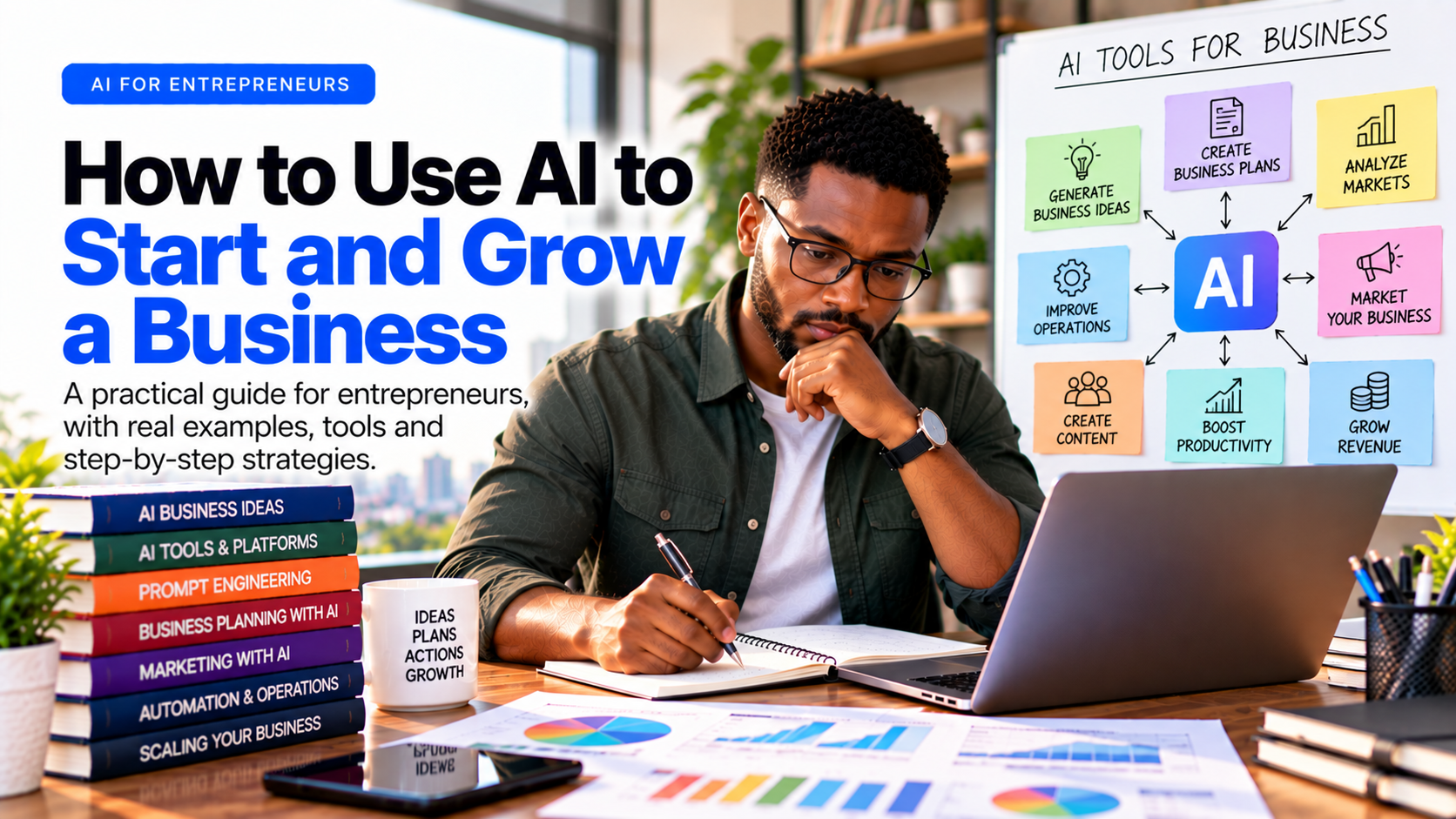
Artificial intelligence has changed the way entrepreneurs can research markets, create content, analyse information, automate repetitive work and make business decisions.
But AI isn't a business strategy.
Simply having access to ChatGPT or another AI tool doesn't automatically give you a successful business.
The real opportunity is to use AI to solve problems faster, reduce costs, improve decisions and create value for customers.
For an entrepreneur, the question shouldn't be:
"How can I use AI?"
It should be:
"Where can AI help me build a better business?"
This guide explains practical ways entrepreneurs can use AI throughout the business journey—from developing an idea to launching, marketing and growing a company.
What Can AI Actually Do for Entrepreneurs?
AI can assist with many business activities, including:
Market research
Business idea evaluation
Customer research
Competitor analysis
Writing and editing
Content creation
Marketing
Sales
Customer support
Data analysis
Financial analysis
Product development
Software development
Administrative tasks
Business planning
Research and decision support
The key word is assist.
AI can dramatically increase what a small team can accomplish, but entrepreneurs still need to provide:
Judgment
Context
Strategy
Creativity
Experience
Verification
Accountability
- Use AI to Research Business Ideas
Before starting a business, entrepreneurs need information.
AI can help you explore:
Customer problems
Industry trends
Potential markets
Business models
Competitors
Pricing approaches
Distribution options
Potential risks
For example, instead of asking:
"Give me 20 business ideas."
Ask:
"Identify underserved problems faced by small restaurants in urban markets and suggest businesses that could solve those problems. For each opportunity, explain the customer, problem, potential solution and possible revenue model."
The second question produces more useful strategic thinking.
Important
AI-generated research should not automatically be treated as fact.
Verify important information using reliable sources, particularly:
Market sizes
Prices
Regulations
Statistics
Legal requirements
Financial information
- Use AI to Evaluate a Business Idea
Before investing money, use AI to challenge your assumptions.
Ask questions such as:
Who is the target customer?
What problem does the business solve?
What alternatives already exist?
What could make the business fail?
What assumptions are most uncertain?
What would customers need to believe before buying?
What competitors could respond?
You can even ask AI to argue against your idea.
For example:
"Act as a skeptical investor. Identify the five strongest reasons this business might fail."
This is often more valuable than asking AI to explain why your idea is excellent.
- Use AI for Market Research
AI can help structure and analyse market research.
You can use it to:
Organise customer interview responses
Identify recurring themes
Segment customers
Summarise research
Generate research questions
Analyse survey responses
Compare competitors
Identify potential positioning opportunities
However, AI shouldn't replace actual customer conversations.
Talking to ten real potential customers can sometimes teach you more than generating hundreds of pages of AI analysis.
Use AI to extend your research—not to manufacture evidence.
- Use AI to Build Customer Personas
AI can help you organise information about your target customers.
For example:
Customer segment
Small-business owners
Common problems
Limited capital
Difficulty attracting customers
Poor financial planning
Limited staff
Goals
Increase revenue
Reduce costs
Expand operations
Buying concerns
Price
Reliability
Ease of use
Return on investment
These insights can then influence your:
Product
Marketing
Sales strategy
Pricing
Customer experience
- Use AI to Develop Your Value Proposition
A business needs to communicate why customers should care.
AI can help you explore different ways of expressing your value proposition.
For example:
"We help small businesses manage inventory."
could become:
"Know what you have, what you're selling and what you need to reorder—without relying on spreadsheets."
The second version focuses more directly on the customer's desired outcome.
Don't simply accept the first AI-generated answer.
Use AI to generate alternatives, then choose and refine the one that genuinely reflects your business.
- Use AI to Create Business Plans
AI can help entrepreneurs structure a business plan.
It can assist with:
Executive summaries
Market analysis
Business models
Marketing strategies
Operations
Risk analysis
Financial assumptions
Implementation plans
But there is a major difference between:
AI writing a generic business plan
and
AI helping you think through your actual business.
The second is much more valuable.
A useful business-planning process should begin with questions about the entrepreneur's actual:
Customers
Products
Market
Operations
Costs
Strategy
Risks
Goals
The resulting plan should reflect those answers rather than generic assumptions.
- Use AI to Build Financial Models
AI can help entrepreneurs understand financial modelling concepts and structure calculations.
You can use it to explore:
Revenue models
Cost structures
Gross margins
Break-even analysis
Cash flow
Scenario analysis
Pricing
Unit economics
For example:
"If my fixed costs are $8,000 per month, my selling price is $40 and my variable cost is $22 per unit, how many units do I need to sell to break even?"
AI can help calculate and explain the result.
But financial assumptions should come from real business information, not AI-generated guesses.
- Use AI to Improve Marketing
Marketing is one of the most accessible applications of AI.
Entrepreneurs can use AI to help create:
Social media posts
Email campaigns
Blog articles
Ad concepts
Headlines
Product descriptions
Video scripts
Marketing calendars
Landing-page copy
AI can also help adapt one idea into multiple formats.
For example:
One article
→ LinkedIn post
→ X post
→ Instagram carousel
→ Newsletter
→ Short video script
→ Sales email
This allows a small marketing team to produce significantly more content.
- Use AI for SEO
AI can help with:
Keyword research
Topic clustering
Content outlines
Search intent analysis
Meta descriptions
Internal linking
Content optimisation
But avoid producing hundreds of generic articles simply because AI makes it easy.
Search engines and, more importantly, customers need useful information.
The goal should be:
Create the best resource for the person searching—not the largest number of AI-generated pages.
- Use AI to Improve Sales
AI can help sales teams with:
Lead research
Prospect qualification
Personalised outreach
Email drafting
Follow-up messages
Proposal preparation
Objection analysis
Sales-call summaries
CRM data analysis
For example, instead of sending the same email to every prospect, AI can help tailor the message based on:
Industry
Company size
Customer problem
Previous interaction
Product relevance
The salesperson still needs to use judgment.
Personalisation that feels obviously automated can damage trust rather than improve it.
- Use AI for Customer Support
AI can help answer routine customer questions.
Examples:
Product information
Pricing
Opening hours
Order status
Basic troubleshooting
Frequently asked questions
This can allow human employees to focus on more complex issues.
However, customers should have a clear path to human assistance when AI cannot solve the problem.
- Use AI to Analyse Business Data
Many small businesses have valuable data but don't use it effectively.
AI can help analyse:
Sales
Expenses
Customer behaviour
Inventory
Marketing performance
Product performance
Cash flow
For example:
"Which products generated the highest gross profit last quarter?"
or:
"Which customers have reduced their purchasing frequency?"
These questions can help turn raw data into decisions.
- Use AI for Operations
AI can help entrepreneurs document and improve business processes.
For example:
Customer order
→ Order received
→ Payment verified
→ Inventory checked
→ Product prepared
→ Quality checked
→ Dispatched
You can use AI to:
Document procedures
Identify bottlenecks
Create checklists
Draft SOPs
Analyse operational data
Suggest process improvements
This becomes particularly useful as a business grows and the founder begins delegating responsibilities.
- Use AI for Hiring
AI can help with parts of the recruitment process.
For example:
Writing job descriptions
Creating interview questions
Organising applications
Comparing candidate information against defined criteria
Preparing onboarding materials
But hiring decisions require human judgment.
AI should not be treated as an unquestionable authority when evaluating people.
- Use AI to Learn Faster
One of the most valuable uses of AI for entrepreneurs is education.
You can use AI as a:
Tutor
Research assistant
Writing coach
Business analyst
Programming assistant
Financial modelling tutor
Strategy sounding board
For example:
"Explain customer acquisition cost to me as if I'm a first-time entrepreneur, then give me three examples and test me with five questions."
This creates an interactive learning experience rather than simply searching for a definition.
- Use AI to Build Prototypes
Entrepreneurs can now use AI-assisted development tools to build prototypes and even production software much faster than before.
AI can help create:
Websites
Landing pages
Internal tools
Dashboards
Mobile experiences
Software prototypes
Automations
This can dramatically reduce the cost and time required to test an idea.
But remember:
Building something is not the same as proving that people want it.
A beautiful prototype without customers is still an unvalidated idea.
- Use AI to Analyse Competitors
AI can help organise competitor research.
Compare:
Products
Pricing
Positioning
Features
Customer segments
Marketing
Distribution
Reviews
The objective isn't to copy competitors.
It's to understand the market and identify opportunities to differentiate.
- Use AI for Business Decision-Making
Entrepreneurs make decisions every day.
AI can serve as a structured thinking partner.
For example:
"I'm deciding between opening a second location and investing in online sales. Here are my current numbers. Analyse both options, identify the assumptions, risks and potential returns, then tell me what information I still need before deciding."
This is much more useful than asking:
"Should I open another location?"
Give AI the context it needs to reason about the problem.
- Automate Repetitive Work
One of AI's biggest benefits is reducing repetitive tasks.
Examples:
Summarising meetings
Drafting emails
Categorising documents
Extracting information
Generating reports
Processing routine customer requests
Creating recurring content
Updating internal records
The objective isn't to automate everything.
It's to identify tasks that consume significant time without requiring much human judgment.
- Use AI to Create a Knowledge Base
As a business grows, important information becomes scattered across:
Documents
Emails
Spreadsheets
Procedures
Customer conversations
Research
Reports
AI can help organise and retrieve this information.
A well-structured business knowledge base can allow employees to find answers without repeatedly asking the founder.
This can become particularly valuable as the company grows.
- Use AI to Improve Productivity
Instead of asking:
"How can I work more?"
Ask:
"Which work should I stop doing manually?"
AI can help reduce the time spent on repetitive activities.
For example, a task that takes two hours every week might be reduced to 20 minutes with the right workflow.
Across dozens of recurring tasks, those savings can become significant.
- Use AI to Prepare for Meetings
Before a meeting, AI can help you:
Summarise background information
Prepare questions
Analyse a proposal
Identify risks
Create an agenda
Prepare talking points
After the meeting, it can help:
Summarise decisions
Identify action items
Draft follow-up messages
Assign responsibilities
This can make meetings much more productive.
- Use AI to Create Better Customer Experiences
AI can help businesses personalise interactions.
For example:
Product recommendations
Personalised email campaigns
Customer segmentation
Automated follow-ups
Support responses
Relevant content
The goal isn't simply automation.
The goal is better service at scale.
- Use AI to Identify Business Risks
Ask AI to challenge your assumptions.
For example:
"Here is my business model. Act as a skeptical risk analyst. Identify the ten most serious risks, rank them by potential impact and likelihood, and suggest mitigation strategies."
This can reveal issues you might not have considered.
But remember:
AI can help identify possible risks. It cannot guarantee that you've identified all of them.
- Use AI to Build a Personal Entrepreneurial Operating System
Entrepreneurs can combine AI with their own workflows to create a personal system for:
Planning
Research
Decision-making
Writing
Learning
Customer management
Task management
Business analysis
The result isn't simply "using AI."
It is creating a business where AI becomes part of how work gets done.
What AI Should Not Replace
AI is powerful, but entrepreneurs should be careful about outsourcing critical judgment.
Don't blindly delegate:
Major financial decisions
Legal decisions
Hiring decisions
Sensitive customer decisions
Strategic decisions
Safety-critical decisions
Ethical decisions
AI can provide analysis and recommendations.
The entrepreneur remains responsible for the decision.
The Biggest Mistake: Using AI Without Context
Consider two prompts.
Weak:
"Create a marketing strategy for my business."
Better:
"I operate a small packaged-food business selling to supermarkets and independent retailers. My average gross margin is 35%, my current monthly sales are $25,000, and I want to reach $50,000 within 12 months. My biggest challenge is customer acquisition. Develop three marketing strategies and explain the expected advantages, risks and resources required."
The second prompt gives AI something to work with.
The principle is simple:
Better context → better analysis → better output.
AI Doesn't Replace Business Thinking
This is perhaps the most important lesson.
AI can generate:
Business plans
Marketing strategies
Product ideas
Financial models
Content
Code
But generating something doesn't mean it is correct, commercially viable or useful.
Entrepreneurs still need to ask:
Is this true?
Does the customer actually want it?
Can we execute it?
Does the economics work?
What evidence supports this assumption?
What could go wrong?
AI should make your thinking stronger—not make thinking unnecessary.
A Practical AI Workflow for Entrepreneurs
A simple workflow could look like this:
- Research
Use AI to gather and organise information.
- Challenge
Ask AI to identify weaknesses and alternative explanations.
- Decide
Use human judgment to choose the direction.
- Create
Use AI to produce drafts, plans, content or prototypes.
- Validate
Test the output against real customers and real-world data.
- Improve
Feed the results back into the process.
This creates a powerful cycle:
Research → Think → Create → Test → Learn → Improve
Final Thoughts
AI gives entrepreneurs access to capabilities that were previously expensive, slow or difficult to obtain.
A small team can now research faster, create more content, analyse information, automate routine work and build products with far fewer resources.
But AI isn't a shortcut around the fundamentals of business.
You still need:
A real customer.
A real problem.
A valuable solution.
A viable business model.
A way to reach customers.
Healthy economics.
Good execution.
The entrepreneurs who benefit most from AI won't necessarily be those who generate the most AI content.
They will be the ones who learn how to combine AI capabilities with strong business judgment.
LoDuko follows the same principle: rather than simply asking AI to write a business plan, it guides entrepreneurs through the questions that matter—helping structure their thinking before transforming that information into professional feasibility reports, business plans and pitch decks.
AI is powerful. But better questions still matter.
Explore LoDuko →