How to Write a Business Plan: A Complete Guide for Entrepreneurs

How to Write a Business Plan: A Complete Guide for Entrepreneurs
Starting a business is exciting. Writing a business plan usually isn't.
Many entrepreneurs open a blank document and immediately face dozens of questions:
What should I write? How much detail is enough? What should my financial projections look like? Do I need market research? What will investors want to see?
The good news is that writing a business plan doesn't have to be complicated.
A good business plan is simply a structured explanation of what your business is, who it serves, how it will make money, what it will require to operate, and why you believe it can succeed.
More importantly, the process of writing one forces you to think through the business before committing significant time and money.
This guide explains how to write a business plan step by step.
What Is a Business Plan?
A business plan is a structured document that explains a business opportunity and how the business intends to pursue it.
It typically covers:
The business and its objectives
Products or services
Target customers
Market and industry
Competitors
Marketing and sales strategy
Operations
Management and staffing
Financial requirements
Revenue and cost projections
Risks and opportunities
Implementation strategy
A business plan can serve several purposes.
You may need one to:
Clarify your business idea
Evaluate whether an opportunity is worth pursuing
Apply for a business loan
Approach investors
Attract business partners
Plan an expansion
Guide your management team
Establish measurable business objectives
But there is an important distinction:
A business plan should not exist simply because someone asked you for one.
The real value is in the thinking that happens while creating it.
Why Should You Write a Business Plan?
A business plan can help you answer some of the most important questions about your business before you invest heavily in it.
- It forces you to define the opportunity
An idea can sound excellent in your head.
Writing it down forces you to explain exactly what you are offering, who will buy it and why they will buy it.
- It exposes assumptions
You may assume that customers will pay a certain price.
You may assume that you can acquire raw materials at a particular cost.
You may assume that your market is large enough.
A business plan gives you a place to identify and test those assumptions.
- It helps you understand the money
A business can have strong sales and still lose money.
Your plan should help you understand:
Startup costs
Operating expenses
Revenue
Gross profit
Net profit
Cash flow
Working capital
Break-even point
- It gives you a roadmap
Once the business launches, the plan can become a reference point for decisions about hiring, marketing, expansion, investment and operations.
- It can help you secure funding
Banks, investors and other funding providers often want to understand the business before committing capital.
A well-prepared business plan gives them a structured way to evaluate the opportunity.
What Should a Business Plan Contain?
There isn't one universal format that every business must follow.
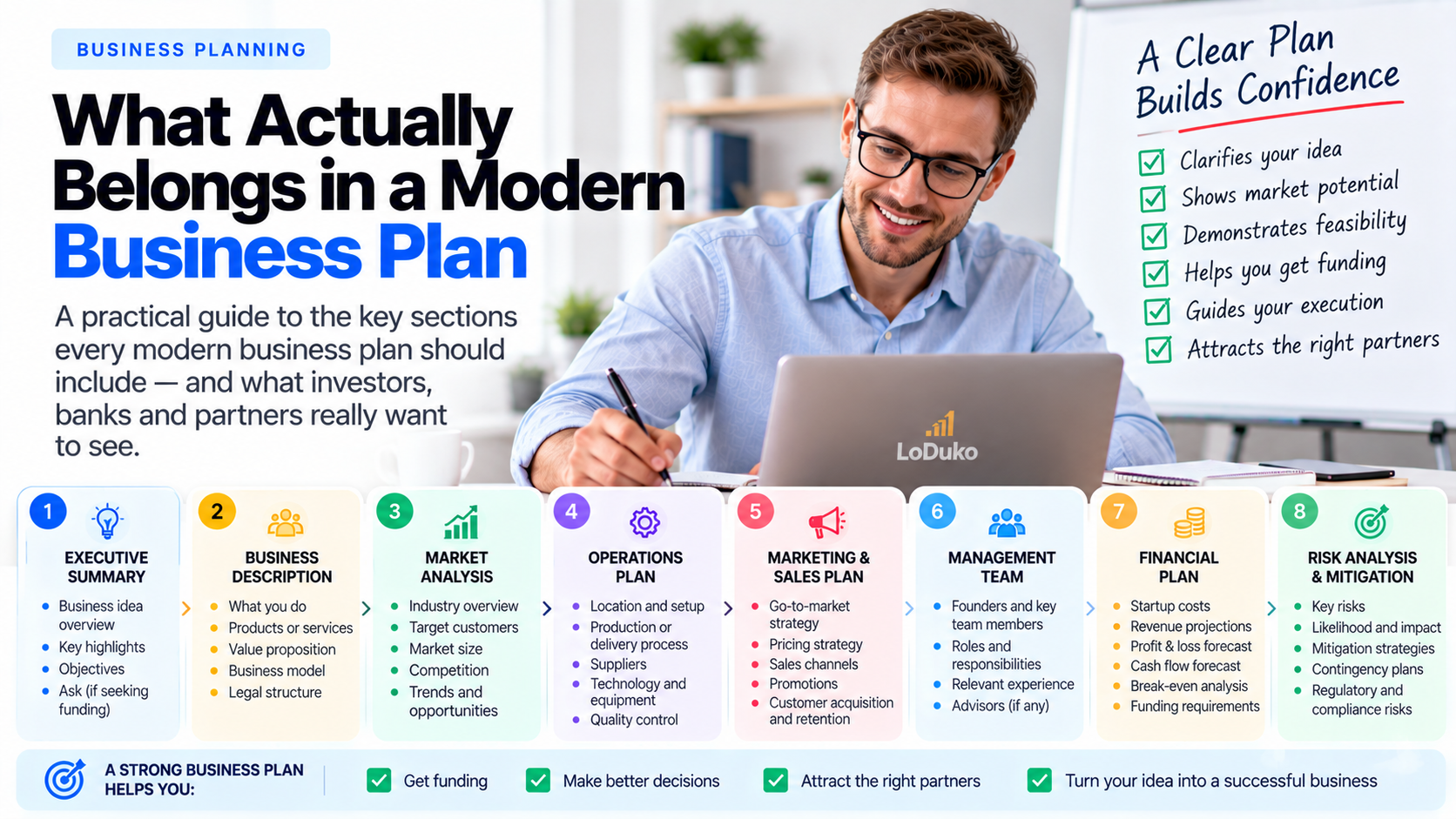
However, a comprehensive business plan will usually contain the following sections:
Executive Summary
Company Overview
Products or Services
Market Analysis
Target Customers
Competitive Analysis
Marketing and Sales Strategy
Operations Plan
Management and Organization
Financial Plan
Risk Analysis
Implementation Plan
Funding Requirements
Let's look at each one.
- Executive Summary
The executive summary provides a concise overview of the entire business plan.
It should explain:
What the business does
The problem it solves
Who its customers are
The market opportunity
How the business makes money
Its competitive advantage
Key financial expectations
Funding requirements, if applicable
Although the executive summary appears first, it's often easier to write it last.
Why?
Because once you've completed the rest of the business plan, you already know what the most important points are.
Example
Instead of:
ABC Foods is a food processing company.
You could write:
ABC Foods produces affordable, nutritious packaged food products for urban consumers, initially targeting households and retailers in Kaduna and neighbouring markets. The company will combine locally sourced raw materials with standardized processing and distribution to address growing demand for convenient, affordable food products.
The second version tells the reader much more about the opportunity.
- Company Overview
This section explains the business itself.
Include information such as:
Business name
Legal structure
Location
Ownership
Founders
Business history, if already operating
Mission
Vision
Business objectives
If the business is already operating, explain its current stage.
For example:
The company began commercial operations in 2025 and currently distributes its products through independent retailers and wholesalers.
If it's a new business, explain what you intend to build.
- Products or Services
Explain exactly what you intend to sell.
For each major product or service, describe:
What it is
What problem it solves
Who needs it
How it is different
How it will be priced
How it will be produced or delivered
Avoid using complicated language simply to make the business sound impressive.
A reader should understand the product quickly.
- Market Analysis
This is one of the most important sections of the business plan.
Your market analysis should demonstrate that you understand the environment in which your business will operate.
Consider:
Industry
What industry are you entering?
How does the industry work?
What trends are affecting it?
Market
How large is the relevant market?
Is it growing, declining or relatively stable?
Customers
Who actually buys the product?
What are their needs, preferences, income levels, locations and buying behaviours?
Competition
Who else is serving the market?
What do they offer?
How do they price their products?
Where are they strong?
Where are they vulnerable?
Regulation
Are there licences, standards, taxes or regulatory requirements affecting the business?
A strong market analysis isn't about finding impressive statistics.
It's about demonstrating that you understand the actual market you intend to enter.
- Define Your Target Customers
"Everyone" is almost never a useful target market.
Instead, define your ideal customers as specifically as possible.
For example:
Small retailers in urban and semi-urban areas purchasing packaged food products for resale.
is more useful than:
People who need food.
Depending on the business, you may define customers by:
Age
Location
Income
Profession
Business size
Industry
Lifestyle
Purchasing behaviour
Specific business needs
A clear customer definition also makes marketing and financial projections more realistic.
- Competitive Analysis
Your competitors aren't necessarily only businesses selling the same product.
Competition can come from:
Direct competitors
Alternative products
Imported products
Substitute services
Informal businesses
Customers doing something themselves
Identify the major competitors and compare factors such as:
Factor Your Business Competitor A Competitor B
Price
Quality
Distribution
Brand
Customer service
Product range
Convenience
Then answer the most important question:
Why should customers choose you?
That answer becomes part of your competitive strategy.
- Marketing and Sales Strategy
Having a good product doesn't automatically create customers.
Your business plan should explain how customers will discover, evaluate and purchase your product.
Consider:
Positioning
How do you want customers to perceive your business?
Pricing
How much will you charge and why?
Promotion
How will customers hear about you?
Potential channels include:
Social media
Search engines
Advertising
Partnerships
Events
Referrals
Distributors
Direct sales
Distribution
How will the product reach customers?
Sales
How will you convert prospects into paying customers?
A good marketing strategy connects these pieces rather than simply listing promotional activities.
- Operations Plan
This section explains how the business will actually function.
Depending on the business, it may cover:
Location
Equipment
Technology
Suppliers
Raw materials
Production
Inventory
Logistics
Staffing
Quality control
Customer service
For a manufacturing business, this section may be extensive.
For a digital business, it may focus more on technology infrastructure, personnel and service delivery.
The objective is simple:
Show that you understand what it will take to deliver the product or service consistently.
- Management and Organization
Who will run the business?
Describe:
Founders
Key management personnel
Their responsibilities
Relevant experience
Staffing requirements
Organizational structure
You don't necessarily need a large team.
What matters is whether the business has the capabilities required to execute its strategy.
If there are important capabilities missing, acknowledge them and explain how you intend to address the gap.
- Financial Plan
This is where your business idea meets reality.
A financial plan may include:
Startup Costs
What will you need to spend before the business begins operating?
Examples:
Equipment
Facility
Registration
Initial inventory
Technology
Marketing
Professional fees
Revenue Forecast
How much do you expect to sell?
Explain the assumptions behind the forecast.
Cost Forecast
What will it cost to operate?
Separate, where appropriate:
Fixed costs
Variable costs
Direct costs
Operating expenses
Profit and Loss
Estimate:
Revenue − Costs = Profit
Cash Flow
Profit isn't the same thing as cash.
A business can be profitable on paper and still run out of money because customers haven't paid, inventory has absorbed cash, or large expenses occur before revenue arrives.
Break-Even Analysis
Determine the sales level at which the business covers its costs.
Funding Requirement
If you are seeking funding, explain:
How much you need
Why you need it
How it will be used
What the funding enables
How the business expects to generate returns or repay the financing
- Risk Analysis
Every business has risks.
A credible business plan doesn't pretend otherwise.
Identify major risks such as:
Market risk
Competition
Supply-chain risk
Regulatory risk
Financial risk
Operational risk
Technology risk
Key-person risk
Then explain how you intend to mitigate them.
This can actually make a business plan more credible, not less.
- Implementation Plan
What happens after the plan is written?
Create a practical roadmap.
For example:
Month 1
Business registration and market validation.
Month 2
Secure premises and equipment.
Month 3
Recruit key staff and begin setup.
Month 4
Production testing and initial marketing.
Month 5
Commercial launch.
The timeline should reflect the actual complexity of the business.
- Funding Requirements
If you're seeking capital, be specific.
Instead of:
We need funding to grow the business.
Say:
The company is seeking $100,000 to expand production capacity, purchase additional equipment, increase working capital and support market expansion.
Then provide a breakdown.
For example:
Use Amount
Equipment $40,000
Working capital $30,000
Marketing $15,000
Facility improvements $10,000
Other costs $5,000
Total $100,000
The more clearly you connect the funding to specific business outcomes, the stronger the request becomes.
Common Business Plan Mistakes
- Writing unrealistic financial projections
A business plan isn't a wish list.
If revenue is projected to grow 300% annually, there should be a credible explanation for why.
- Claiming there is no competition
Almost every business has competition.
Even if there isn't a direct competitor, there are usually alternatives.
- Making the target market too broad
"Everyone in the country" is rarely a useful starting market.
- Focusing too much on the product
Customers don't buy products simply because they exist.
Explain the problem being solved.
- Ignoring costs
Entrepreneurs often estimate revenue carefully while underestimating expenses.
That's dangerous.
- Treating the business plan as a one-time document
Markets change.
Costs change.
Customers change.
Your plan should evolve with the business.
- Writing what investors want to hear
This is perhaps the most damaging mistake.
A business plan should represent the business honestly.
The purpose isn't to make the business look perfect. It's to understand whether the business is actually worth pursuing.
How Long Should a Business Plan Be?
There is no magic number.
A simple business may need a relatively concise plan.
A complex manufacturing company seeking significant financing may require considerably more detail.
The right question isn't:
"How many pages should my business plan be?"
It is:
"Does this plan contain enough credible information for the reader to understand and evaluate the business?"
Quality matters more than page count.
Business Plan vs. Feasibility Study
These documents are related but serve different purposes.
A feasibility study primarily asks:
"Is this business opportunity worth pursuing?"
A business plan asks:
"How are we going to build and operate this business?"
This distinction is important.
For an entrepreneur considering a major investment, it can make sense to evaluate the opportunity first and develop the detailed business plan after determining that the opportunity is worth pursuing.
Business Plan vs. Pitch Deck
A business plan is a detailed document.
A pitch deck is a concise presentation designed to communicate the most important aspects of a business opportunity to an audience such as investors or partners.
Think of it this way:
Feasibility Study → Should we pursue it?
Business Plan → How will we build it?
Pitch Deck → How do we communicate the opportunity?
The three can work together rather than being treated as competing documents.
A Better Way to Approach Business Planning
Don't begin by opening Microsoft Word or Google Docs.
Begin by thinking.
Ask:
What problem am I solving?
Who has this problem?
How serious is the problem?
What solution am I offering?
Why will customers choose it?
Who are my competitors?
How will I reach customers?
How will the business make money?
What will it cost to operate?
What could cause the business to fail?
How much capital do I need?
What needs to happen before launch?
Once you have credible answers, writing the actual document becomes considerably easier.
That's also why structured business interviews can be more useful than simply asking an AI to "write me a business plan."
The quality of the document depends heavily on the quality of the information and thinking behind it.
Final Checklist
Before considering your business plan complete, make sure you can answer yes to these questions:
[ ] Is the business clearly explained?
[ ] Is the customer clearly defined?
[ ] Is the problem clearly identified?
[ ] Is the market properly researched?
[ ] Are competitors identified honestly?
[ ] Is the business model clear?
[ ] Is the marketing strategy realistic?
[ ] Are operations explained?
[ ] Are the key people identified?
[ ] Are financial assumptions realistic?
[ ] Are startup and operating costs included?
[ ] Is cash flow considered?
[ ] Are major risks identified?
[ ] Is the funding requirement specific?
[ ] Is there a practical implementation plan?
If several answers are "no," the business may need more work before the document is finalized.
The Business Plan Is Not the Business
A beautifully formatted 40-page document doesn't make a business viable.
The real value of business planning is the thinking that happens before, during and after the document is created.
A good business plan should help you see your opportunity more clearly, identify weaknesses before they become expensive problems, understand what resources you need, communicate your strategy to others, and make better decisions.
Don't write a business plan just because someone asks for one.
Write one because you want to understand the business you're about to build.
Ready to plan your business?
LoDuko helps entrepreneurs work through a structured business interview and turn their answers into professional Feasibility Reports, Business Plans, and Pitch Decks—without starting from scratch each time.
Plan, validate, and launch your business with confidence.
LoDuko — Business Intelligence Platform.