How a Small Food Business Can Grow From a Kitchen Operation Into a Factory
A practical case study of how entrepreneurs can move from small-scale food production to a structured manufacturing business.
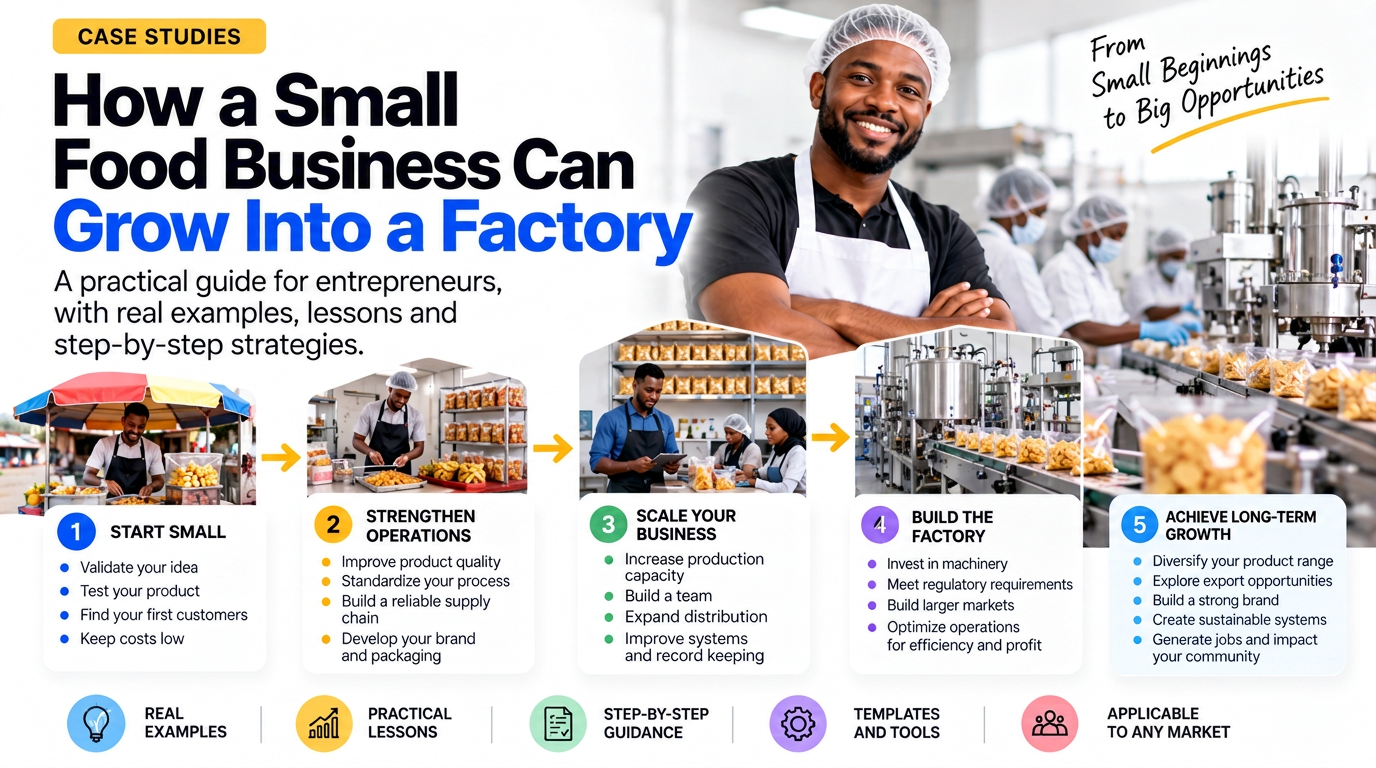
Many successful food businesses begin in ordinary places.
A home kitchen.
A rented room.
A small workshop.
A market stall.
A modest production facility.
The first batches may be produced by the founder and a few helpers. Customers are acquired through personal relationships, social media and word of mouth.
Then demand begins to grow.
Orders become larger.
Retailers start asking for consistent supply.
The founder faces a new problem:
How do you turn a small food operation into a real manufacturing business without losing control of quality, cash flow or customers?
This hypothetical case study follows a small food business through that transition.
The numbers are illustrative rather than financial benchmarks. Actual costs, regulations, equipment requirements and margins vary significantly by product, market and country.
The Starting Point: A Kitchen Business
Imagine a food entrepreneur named Maya.
Maya starts a small packaged-food business from a rented commercial kitchen.
Her first product is a shelf-stable snack sold in retail packs.
At the beginning, Maya handles almost everything:
Product development
Purchasing
Production
Packaging
Sales
Customer service
Bookkeeping
Deliveries
Social media
She has five part-time workers.
The business sells approximately $8,000 per month.
It is profitable, but the business is highly dependent on Maya.
If she doesn't work, production slows.
If she doesn't follow up with customers, sales fall.
If she doesn't inspect production, quality problems appear.
The business has customers.
But it doesn't yet have a scalable operating system.
Stage 1: Prove That Customers Want the Product
Maya's first important decision is not buying machinery.
It is proving demand.
She starts by answering several questions:
Who buys the product?
Why do they buy it?
How frequently do they purchase?
What alternatives do they have?
What price are they willing to pay?
Which channels generate the most sales?
Which customers reorder?
What complaints do customers have?
This changes the conversation from:
"I have a product. How can I produce more?"
to:
"I have evidence that customers want this product. How can I reliably supply them?"
That distinction is critical.
Stage 2: Understand the Unit Economics
Before expanding production, Maya calculates the economics of one retail pack.
Suppose the average selling price is:
$4.00
Variable costs per pack:
Ingredients: $1.10
Packaging: $0.35
Direct labour: $0.30
Variable utilities: $0.10
Distribution-related cost: $0.25
Total variable cost:
$2.10
Contribution per pack:
$1.90
That tells Maya much more than simply knowing that the business is "profitable."
She can now ask:
How many units must I sell to cover my fixed costs?
Stage 3: Calculate Break-Even
Suppose monthly fixed costs are approximately $9,500.
The contribution per pack is $1.90.
Break-even volume is:
$9,500 ÷ $1.90 = 5,000 packs per month
Maya therefore needs to sell approximately 5,000 packs per month to cover fixed costs under these assumptions.
Anything beyond that contributes toward profit and growth.
This calculation becomes extremely important when considering factory investment.
Stage 4: Find the Bottleneck
Demand increases.
Maya's kitchen can now produce approximately 7,000 packs per month.
But customers want 12,000.
At first, she assumes the solution is a larger facility.
But she investigates the operation.
She discovers the real bottleneck is packaging.
Production can make enough product.
Packaging cannot keep up.
This is a critical lesson:
Don't expand everything when only one part of the system is limiting growth.
Sometimes the right investment is a packaging machine, additional labour or a better workflow—not a factory.
Stage 5: Standardize the Product
Before expanding, Maya standardizes the production process.
She documents:
Ingredient specifications
Ingredient quantities
Production sequence
Processing times
Temperature requirements
Quality standards
Packaging specifications
Labelling requirements
Storage conditions
Cleaning procedures
Batch numbering
Product-release procedures
This creates a consistent production system.
The product should not taste different simply because a different employee prepared it.
Stage 6: Create a Bill of Materials
Maya creates a Bill of Materials (BOM).
For every batch, she knows exactly what materials are required.
For example:
Input Quantity per batch
Ingredient A 20 kg Ingredient B 8 kg Ingredient C 4 kg Packaging 1,000 units Labels 1,000 units
This makes purchasing and inventory management much easier.
It also makes production costing more accurate.
Stage 7: Build Quality Control Into Production
A common mistake is treating quality control as something that happens at the end.
Instead, Maya introduces quality checks throughout production.
Incoming materials
Check:
Quantity
Specification
Condition
Supplier information
During production
Check:
Process parameters
Product consistency
Batch records
Finished product
Check:
Weight
Packaging
Appearance
Labelling
Required quality parameters
Storage conditions
Depending on the product and jurisdiction, food businesses may also need appropriate testing, food-safety systems, certifications and regulatory approvals.
The exact requirements should be determined with qualified local professionals and the relevant authorities.
Stage 8: Separate the Founder From Production
Maya has a problem.
She still personally supervises every batch.
This limits growth.
She appoints a production supervisor.
Instead of Maya checking everything, the supervisor becomes responsible for:
Production schedules
Staff allocation
Batch records
Production output
Quality checks
Equipment issues
Daily production reporting
Maya still monitors the system.
But she no longer needs to stand beside the production line every day.
This is a major transition.
Stage 9: Build a Real Sales System
More production capacity means little if products don't sell.
Maya therefore builds a structured sales system.
She divides customers into channels:
Direct consumers
Website
Social media
Direct orders
Retail
Independent stores
Supermarkets
Specialty shops
Wholesale
Distributors
Regional wholesalers
Institutional
Offices
Hospitality businesses
Schools or other eligible institutional customers
Each channel has different economics.
Maya tracks:
Revenue
Gross margin
Order frequency
Average order size
Payment terms
Customer acquisition cost
Delivery costs
Returns or complaints
This prevents the business from confusing sales volume with profitable sales.
Stage 10: Don't Confuse Revenue With Cash
The business begins supplying larger retailers.
Sales increase dramatically.
Monthly revenue reaches $50,000.
Maya celebrates.
Then she discovers something uncomfortable.
Several large customers pay 30–60 days after delivery.
Meanwhile, Maya must pay:
Employees
Suppliers
Utilities
Transport providers
Packaging suppliers
Rent
Other operating costs
The business is profitable on paper but increasingly short of cash.
This is a classic working-capital problem.
Stage 11: Calculate Working Capital Before Expanding
Maya now models:
Inventory + Receivables − Payables
If she must hold $30,000 of inventory and customers owe her $40,000 while suppliers provide $20,000 of credit, significant cash is tied up.
Growth can actually make the cash problem worse.
This is why entrepreneurs should ask:
"How much working capital will I need to support the next stage of growth?"
—not simply:
"How much will the factory cost?"
Stage 12: Decide Whether to Build a Factory
Maya now has three options.
Option 1: Expand the existing facility
Lower capital requirement.
Option 2: Rent a larger production facility
Moderate capital requirement and potentially faster expansion.
Option 3: Build or acquire a dedicated factory
Higher capital requirement but potentially greater long-term capacity and control.
She evaluates each option based on:
Demand
Capacity requirements
Capital available
Return on investment
Regulatory requirements
Supply chain
Utilities
Labour
Distribution
Future growth
Operational risk
The decision is based on economics—not excitement.
The Factory Investment Decision
Suppose the proposed facility requires:
Equipment: $180,000
Facility preparation: $70,000
Installation: $30,000
Quality and production equipment: $25,000
Initial inventory: $45,000
Working capital: $100,000
Other startup costs: $25,000
Total estimated requirement:
$475,000
Maya should not ask only:
"Can I raise $475,000?"
She should ask:
"Can the business generate enough profitable demand to justify and support a $475,000 investment?"
That is a much better investment question.
Stage 13: Build the Factory Around the Process
If Maya proceeds, she designs the facility around the production flow.
A simplified flow might be:
Receiving → Raw Material Storage → Preparation → Processing → Quality Control → Packaging → Finished Goods Storage → Dispatch
The goal is to minimize:
Unnecessary movement
Cross-contamination risks
Bottlenecks
Excess handling
Wasted space
Safety risks
Factory layout should support the process rather than simply placing machines wherever space happens to exist.
Stage 14: Choose Equipment Based on Capacity
Maya receives several equipment proposals.
One supplier recommends a machine capable of producing 50,000 units per day.
Another recommends equipment capable of 20,000.
Her current realistic demand is 12,000 units per month.
Buying the larger system because "we are going to grow" could create unnecessary capital costs.
She instead asks:
What capacity do we need now?
What capacity is likely within 3–5 years?
Can production be expanded modularly?
What is the machine's actual usable capacity?
What is the maintenance requirement?
What happens if the machine breaks?
Are spare parts available?
What technical support exists?
What energy does it consume?
What is the total cost of ownership?
Capacity should follow a credible demand forecast.
Stage 15: Build Supplier Relationships
A factory depends on reliable inputs.
Maya therefore develops multiple supplier options for critical materials.
For important inputs, she tracks:
Supplier
Price
Quality
Lead time
Minimum order quantity
Payment terms
Reliability
Location
Alternative suppliers
For critical materials, depending on the business, having a qualified backup supplier can reduce operational risk.
Stage 16: Build Inventory Discipline
Too little inventory can stop production.
Too much inventory can trap cash.
Maya introduces:
Minimum stock levels
Reorder points
Stock counts
Inventory records
Batch tracking
Expiry monitoring where applicable
Slow-moving inventory reports
Inventory is not simply "stuff in the warehouse."
It is cash converted into materials and products.
Stage 17: Build a Distribution System
Producing the product is only half the job.
Maya needs to get it into customers' hands.
She develops a distribution model using:
Direct delivery
Distributors
Wholesalers
Retail partners
Online orders
She compares each channel based on:
Margin
Volume
Reach
Payment terms
Delivery cost
Customer acquisition
Control over the customer relationship
The cheapest channel isn't always the best.
The right channel is the one that creates sustainable economics.
Stage 18: Protect the Brand
As production grows, Maya's brand becomes more valuable.
She establishes standards for:
Packaging
Product appearance
Product claims
Customer communication
Pricing
Retail presentation
Digital presence
Growth can expose a brand to more customers—and therefore more opportunities for both positive and negative experiences.
Consistency becomes increasingly important.
Stage 19: Build Management Systems
At the kitchen stage, Maya could manage the company from her phone.
At factory scale, that becomes dangerous.
She introduces regular reporting.
Daily
Production output
Downtime
Quality issues
Orders
Dispatches
Weekly
Sales
Inventory
Cash collection
Production efficiency
Customer issues
Monthly
Revenue
Gross margin
Operating expenses
Cash flow
Inventory
Receivables
Payables
Profitability
Management now operates from information, not intuition alone.
Stage 20: Scale Carefully
After two years, Maya's business has grown from approximately:
$8,000/month → $100,000/month
But the most important change isn't revenue.
The company now has:
Documented processes
Trained employees
Production systems
Quality controls
Sales channels
Supplier relationships
Financial controls
Inventory systems
Management reporting
Defined responsibilities
Maya is no longer simply running a food-production operation.
She is running an organization.
What Maya Did Right
The biggest lessons from the case are not about food manufacturing.
They are about business thinking.
She validated demand before investing heavily.
She understood unit economics.
She identified the actual bottleneck.
She standardized production.
She separated responsibilities.
She treated working capital as seriously as equipment.
She built distribution alongside production.
She introduced management systems before complexity became overwhelming.
She scaled capacity according to credible demand.
She gradually moved from doing the work to managing the system.
What Could Have Gone Wrong?
The same business could easily have failed.
Imagine Maya had done the following:
Bought expensive equipment before validating demand
Borrowed heavily without modelling cash flow
Ignored working capital
Relied on one major customer
Failed to standardize quality
Had no inventory controls
Accepted long customer payment terms without planning
Built excessive production capacity
Focused on revenue instead of contribution margin
Allowed the founder to remain the only decision-maker
The factory could have become a financial burden rather than a growth engine.
This is why growth itself is not the objective.
Profitable, sustainable growth is.
The Growth Path
The journey can be summarized as:
Kitchen → Validated Product → Repeat Customers → Standardized Production → Small Facility → Structured Operation → Larger Facility → Scalable Manufacturing Business
But entrepreneurs should not assume every business needs to reach the factory stage.
Sometimes the best business is a highly profitable small operation.
The correct question is:
What scale makes economic sense for this particular business?
The Manufacturing Readiness Checklist
Before investing heavily in production capacity, ask:
Market
[ ] Is there demonstrated demand?
[ ] Are customers buying repeatedly?
[ ] Is the target market large enough?
[ ] Do we understand competitors?
Product
[ ] Is the product standardized?
[ ] Are quality specifications documented?
[ ] Is the product commercially differentiated?
Economics
[ ] Do we understand unit economics?
[ ] Do we know gross margin?
[ ] Do we know break-even volume?
[ ] Have we modelled cash flow?
[ ] Have we calculated working-capital requirements?
Operations
[ ] Is the production process documented?
[ ] Are suppliers reliable?
[ ] Are critical inputs available?
[ ] Is quality control established?
[ ] Is inventory controlled?
Investment
[ ] Is additional capacity actually needed?
[ ] Have different capacity options been compared?
[ ] Have total costs been calculated?
[ ] Is there enough working capital?
[ ] Has downside risk been tested?
Management
[ ] Are responsibilities clear?
[ ] Are processes documented?
[ ] Are managers in place?
[ ] Are KPIs tracked?
[ ] Is the business still too dependent on the founder?
If many of these questions cannot be answered, the business may not yet be ready for a major manufacturing investment.
Final Lesson
The journey from a kitchen operation to a factory is not fundamentally a story about buying machines.
It is a story about building a business capable of handling complexity.
The entrepreneur must gradually move from:
Product → Market → Economics → Processes → People → Systems → Capacity → Scale
The factory should be the result of a strong business model—not an attempt to create one.
The most important question is therefore not:
"How do I build a factory?"
It is:
"How do I build a business that deserves a factory?"
Once you can answer that question with evidence, the path to expansion becomes much clearer.
Turn Your Business Idea Into a Structured Business Case With LoDuko
Before investing in a new business, production facility or expansion, entrepreneurs need to understand the market, customers, operations, costs, funding requirements, risks and financial potential.
LoDuko helps you structure those decisions through a guided business interview and generate professional business documents from the information you provide.
Use LoDuko to develop a Feasibility Report, Business Plan or Pitch Deck without repeatedly starting from a blank page.
Plan. Validate. Launch. With confidence.
Explore LoDuko at loduko.com.