How to Fund a Small Business: 12 Funding Options for Entrepreneurs
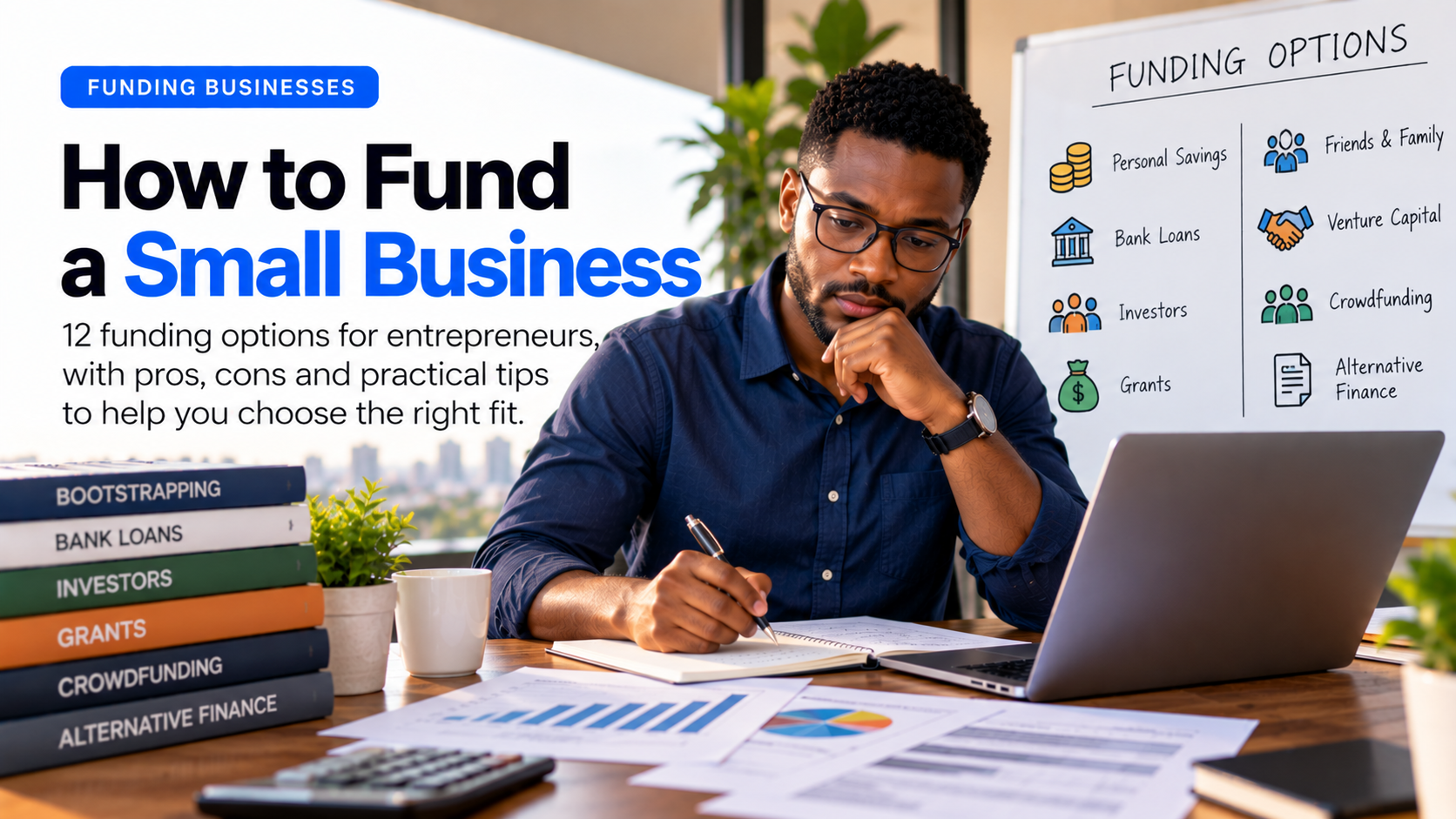
Starting or growing a business requires more than a good idea.
You may need money to purchase equipment, buy inventory, rent a facility, hire employees, develop a product, market your business, or simply keep the business operating while revenue grows.
The challenge is that not every business needs the same type of funding—and not every source of funding is appropriate for every entrepreneur.
A small retail business may need a relatively small amount of working capital. A manufacturing company may require millions for machinery and infrastructure. A technology startup may need funding before it generates meaningful revenue.
Understanding your options can help you choose the right source of capital without giving away unnecessary ownership or taking on debt the business cannot comfortably repay.
This guide examines 12 ways entrepreneurs can fund a small business, including their advantages, disadvantages, and when each option makes sense.
- Personal Savings
For many entrepreneurs, personal savings are the first source of business capital.
This is commonly called bootstrapping.
You use your own money to launch or grow the business instead of relying on external investors or lenders.
Advantages
No interest payments
No investor giving up ownership
Complete control of the business
Can demonstrate commitment to future investors
Simple and fast
Disadvantages
Your personal money is at risk
Limited capital may restrict growth
You may need to delay other personal financial goals
Best for
Small businesses with relatively low startup costs or entrepreneurs who want to validate an idea before seeking external funding.
- Friends and Family
Friends and family can sometimes provide startup capital when traditional lenders or investors are unwilling to fund a new business.
The money may be structured as:
A loan
An investment
A gift
Convertible funding
The biggest advantage is often trust.
However, mixing business and personal relationships can create problems if expectations aren't clearly defined.
If someone gives you money as a loan, document:
Amount
Repayment schedule
Interest, if applicable
What happens if repayment is delayed
Other relevant terms
Never assume that a verbal agreement is enough simply because you know the person.
- Business Revenue
One of the healthiest ways to finance a business is through the business itself.
Instead of constantly seeking external capital, you can reinvest profits into:
Inventory
Equipment
Marketing
Employees
New products
Expansion
This is particularly powerful once the business has achieved consistent profitability.
For example, a small food-processing company might use profits from its existing product line to gradually purchase additional equipment rather than borrowing the entire expansion cost.
The limitation
You can only reinvest money that the business actually generates.
If the business needs $500,000 to launch but is currently generating no revenue, retained profits aren't an immediate funding solution.
- Bank Loans
Traditional bank financing remains an important source of business capital.
Depending on the lender and the business, financing may be available for:
Working capital
Equipment
Expansion
Vehicles
Property
Inventory
The advantage is that you generally don't have to give the lender ownership of your business.
But the business must repay the loan, usually with interest.
Banks may also require:
Financial records
Business registration
Bank statements
Cash-flow information
Collateral
Evidence of repayment capacity
Business plans or projections
Important
Don't borrow simply because a loan is available.
The key question is:
Can the business generate enough cash to comfortably service the debt?
- Microfinance and Small-Business Lenders
Microfinance institutions and other specialised lenders may serve smaller businesses that don't meet the requirements of conventional banks.
They can sometimes provide financing for:
Inventory
Working capital
Small equipment
Business expansion
They may have simpler requirements than traditional banks.
However, entrepreneurs should carefully compare:
Interest rates
Fees
Repayment frequency
Collateral requirements
Penalties
Total repayment amount
A loan that appears affordable because of a small periodic payment can become expensive when the total cost is calculated.
- Government Grants and Programmes
Governments and public agencies sometimes provide grants, subsidised financing, training, or other support to entrepreneurs.
These programmes may target:
Youth entrepreneurs
Women-owned businesses
Agriculture
Manufacturing
Technology
Export businesses
Small and medium-sized enterprises
A genuine grant generally does not require repayment, although recipients may have reporting, eligibility, or performance obligations.
The challenge
Government programmes can be:
Competitive
Periodic
Sector-specific
Limited in funding
Subject to eligibility requirements
Don't build your entire business around the assumption that a grant will arrive.
Treat grants as an opportunity, not a business model.
- Angel Investors
Angel investors are individuals who invest their personal money into businesses, usually in exchange for equity or another investment arrangement.
They are often interested in businesses with significant growth potential.
Beyond money, an experienced angel investor may provide:
Mentorship
Industry contacts
Strategic advice
Customers
Partnerships
Credibility
But raising equity means giving up some ownership and potentially some influence over the company.
Angel investment is therefore usually more suitable for businesses that have the potential to grow substantially.
- Venture Capital
Venture capital is another form of equity financing.
Venture capital firms invest in companies they believe can grow significantly and eventually produce a substantial return.
This makes VC particularly relevant to certain:
Technology startups
Scalable platforms
High-growth companies
Innovative businesses
It is generally not the right funding source for every small business.
A profitable local restaurant, small retail shop, or conventional trading business may be better suited to bootstrapping or debt financing.
What investors want
Investors typically look beyond the business idea.
They may examine:
Market size
Growth rate
Business model
Competitive advantage
Team
Traction
Unit economics
Scalability
Exit potential
So having a business idea isn't enough.
You need to build a business that can produce an attractive investment return.
- Crowdfunding
Crowdfunding allows a business to raise money from a large number of people, usually through an online platform.
Different crowdfunding models exist.
Reward-based crowdfunding
People contribute money and receive a product, service, or other reward.
Equity crowdfunding
People invest in exchange for an ownership interest, where permitted by applicable regulations.
Donation-based crowdfunding
People contribute without expecting a financial return.
Crowdfunding can also serve as a marketing exercise because it allows entrepreneurs to test whether people are interested enough in an idea to support it financially.
- Supplier Credit
You don't always have to raise cash before purchasing everything your business needs.
Some suppliers may allow you to receive goods or raw materials and pay later.
This is known as trade credit or supplier credit.
For example:
A distributor may supply inventory today and allow the retailer to pay after 30 days.
If the retailer sells the inventory within that period, the business can effectively finance part of its operations through the supplier.
Why it can be powerful
It reduces the amount of working capital the business needs upfront.
But be careful
Late payments can damage supplier relationships and may result in penalties or loss of credit terms.
- Strategic Partnerships
A strategic partner can sometimes provide resources that would otherwise require significant capital.
For example, a partner might contribute:
Equipment
Distribution
Technology
Manufacturing capacity
Market access
Facilities
Expertise
Capital
In exchange, the partner may receive:
Revenue share
Equity
Exclusive rights
Long-term commercial benefits
Strategic partnerships can be particularly useful when the business needs capabilities as much as it needs money.
- Pre-Sales and Customer Financing
One of the most overlooked funding strategies is getting customers to commit before you fully deliver the product or service.
Examples include:
Pre-orders
Deposits
Advance payments
Annual contracts
Memberships
Purchase commitments
Suppose you manufacture a product that requires $50,000 of working capital.
Instead of borrowing the entire amount, you may be able to secure customer orders and deposits that provide part of the required working capital.
This isn't possible for every business, but when it works, it can significantly reduce financing requirements.
Debt vs Equity: Which Should You Choose?
Most external business funding falls into two broad categories:
Debt
You borrow money and repay it.
Examples:
Bank loans
Microfinance loans
Supplier credit
You retain ownership but take on repayment obligations.
Equity
Someone invests money in exchange for ownership or an economic interest in the business.
Examples:
Angel investment
Venture capital
Equity crowdfunding
You don't generally have the same fixed repayment obligation, but you give up some ownership and potentially some control.
A Simple Comparison
Funding Source Repayment? Give Up Ownership? Best For
Personal savings No No Early-stage businesses Friends & family Depends Depends Early-stage businesses Business profits No No Existing businesses Bank loan Yes No Established businesses Microfinance Yes No Smaller businesses Government grant Usually no Usually no Eligible businesses Angel investor No fixed repayment Yes High-growth businesses Venture capital No fixed repayment Yes Scalable startups Crowdfunding Depends Depends Consumer-facing ideas Supplier credit Yes No Inventory/operations Strategic partnership Depends Depends Expansion/capability Pre-sales No No Businesses with strong demand
How Much Funding Does Your Business Actually Need?
Before looking for money, determine how much you actually need.
This sounds obvious, but many entrepreneurs start with:
"I need funding."
The better question is:
"How much capital do I need, what exactly will it be used for, and what will it accomplish?"
Break your funding requirement into categories.
For example:
Startup capital
Equipment
Facility
Registration
Initial inventory
Technology
Setup costs
Working capital
Raw materials
Salaries
Utilities
Logistics
Marketing
Operating expenses
Growth capital
New equipment
New locations
Additional employees
Product development
Market expansion
Then determine the minimum amount required to achieve the next meaningful milestone.
Don't Raise More Money Than You Need
More funding isn't always better.
If you raise too much debt, you increase repayment pressure.
If you raise too much equity, you may give away more ownership than necessary.
The objective should be:
Raise enough capital to reach the next important business milestone—not simply the largest amount you can obtain.
For a startup, that milestone might be:
Build → Launch → Acquire customers → Prove demand → Scale.
For an established business, it might be:
Purchase equipment → Increase capacity → Increase sales → Generate additional cash flow.
Make Your Business Funding-Ready
Before approaching a lender, investor, grant programme, or strategic partner, prepare your business.
At minimum, you should understand:
What your business does
Who your customers are
The size of your market
Your competitors
Your business model
Your revenue
Your costs
Your margins
Your funding requirement
How the money will be used
Your financial projections
Your major risks
Why you believe the business can succeed
Depending on the funding source, you may also need:
Business registration documents
Financial statements
Bank statements
Tax records
Contracts
Licences
Business plan
Feasibility study
Pitch deck
Management information
The more organised your business is, the easier it becomes for someone else to understand the opportunity.
The Biggest Funding Mistake Entrepreneurs Make
Many entrepreneurs think the biggest challenge is finding money.
Often, it isn't.
The bigger challenge is building a business that deserves funding.
If your business has:
Weak demand
Unclear customers
Poor margins
No competitive advantage
Unrealistic projections
Weak financial controls
No clear use for the money
raising more capital won't necessarily solve the problem.
It may simply allow you to lose money faster.
Funding should accelerate a viable business—not rescue an idea that hasn't been properly tested.
Final Thoughts
There is no single "best" way to fund a business.
The right option depends on:
The type of business
Its stage
Capital requirements
Cash flow
Growth potential
Risk
Your willingness to share ownership
Your ability to repay debt
A small business may begin with personal savings and customer revenue.
An established company may use bank financing.
A high-growth startup may pursue angel or venture capital.
A manufacturing project may combine equity, debt, supplier credit and strategic partnerships.
The important thing is to understand your business before choosing your funding source.
Before asking:
"Where can I get money?"
Ask:
"What does my business need, how much does it need, what will the money accomplish, and can the business support the funding?"
Those questions can lead to much better financing decisions.
And before approaching a lender or investor, make sure you understand the business you are asking them to fund.
LoDuko helps entrepreneurs structure that thinking through a guided business interview and turn their answers into professional feasibility reports, business plans and pitch decks.
Plan. Validate. Fund. Launch.
Explore LoDuko →