How to Build and Lead a High-Performing Small Business Team
A practical guide to hiring the right people, creating accountability, developing employees and building a team that can grow with your business.
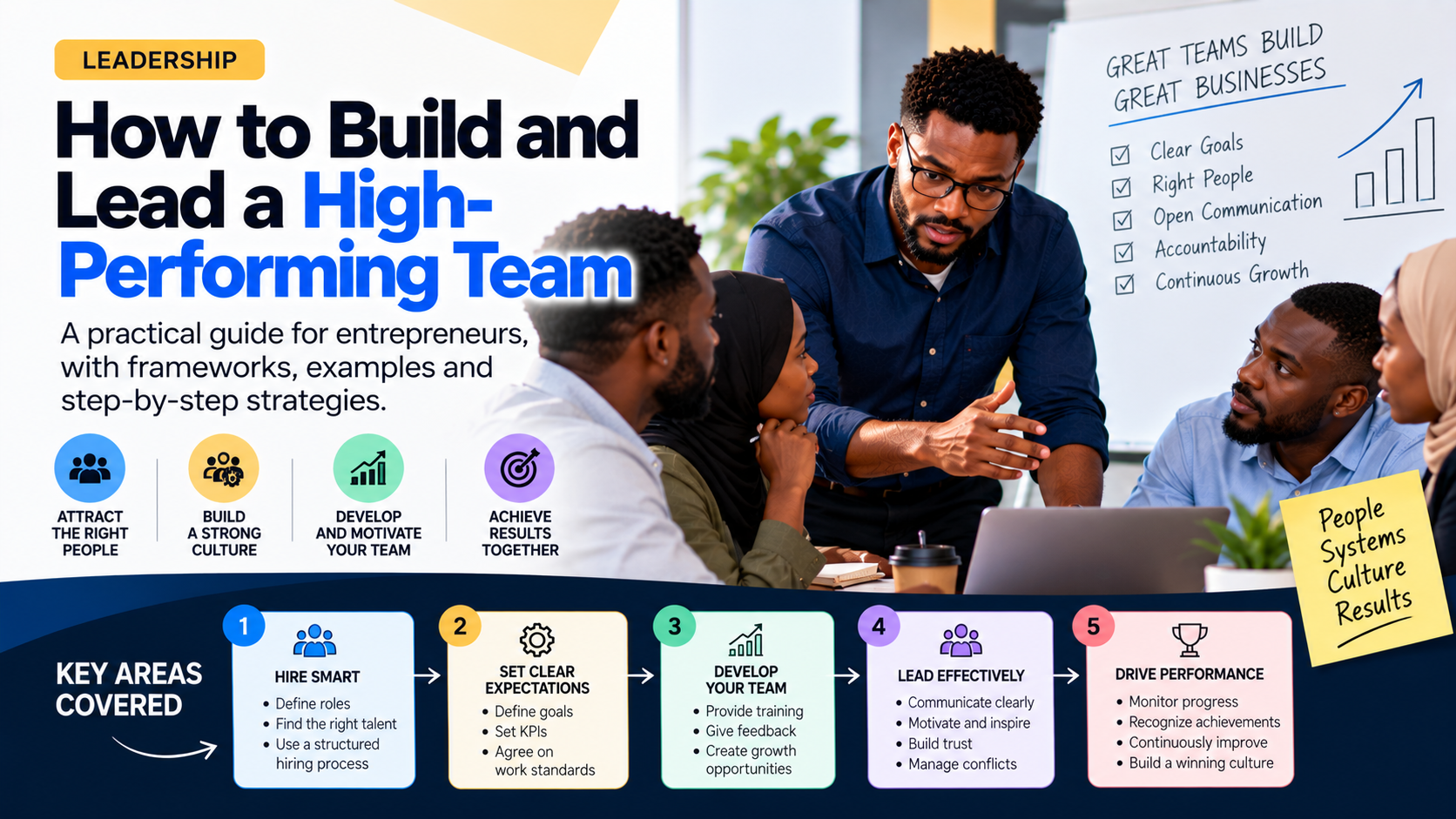
A small business often begins with one person doing almost everything.
The founder finds customers, handles operations, manages money, solves problems and makes decisions.
That may be necessary at the beginning.
But eventually, the founder reaches a limit.
There are only so many hours in a day. And if every important decision still requires the founder, the business cannot grow efficiently.
The solution is not simply to hire more people.
It is to build a high-performing team with clear responsibilities, the right skills, effective management and a culture that supports execution.
This guide explains how entrepreneurs can build and lead such a team.
What Is a High-Performing Team?
A high-performing team is not simply a group of hardworking employees.
It is a group of people who:
Understand what the business is trying to achieve
Know what is expected of them
Have the skills and resources to perform
Take responsibility for their results
Communicate effectively
Work toward shared objectives
Learn from mistakes
Solve problems instead of constantly escalating them
Consistently deliver results
The key word is performance.
A busy team is not necessarily a productive team.
Why Small Businesses Struggle With People
Many entrepreneurs experience the same problems as their business grows:
Employees wait for instructions.
Nobody clearly owns important tasks.
The founder becomes the bottleneck.
Good employees leave.
Poor performers remain too long.
Communication breaks down.
Employees don't understand business objectives.
Training is inconsistent.
Performance is difficult to measure.
The founder ends up doing work that should have been delegated.
These problems are rarely solved by simply hiring more people.
They require better team design and management systems.
Step 1: Define What the Business Needs
Don't begin with:
"I need three employees."
Begin with:
"What work needs to be done for this business to succeed?"
List the major functions required.
For example, a growing consumer-products business might need:
Sales
Marketing
Production
Procurement
Inventory
Quality control
Logistics
Finance
Customer service
Administration
One person may initially handle several functions.
That's perfectly normal.
The important thing is understanding the functions before designing the team.
Step 2: Hire for Outcomes, Not Just Job Titles
A job title doesn't tell you what success looks like.
Instead of simply hiring a "Sales Officer," define the expected outcomes.
For example:
Sales Officer
Responsibilities
Generate leads
Contact prospects
Conduct sales conversations
Prepare quotations
Follow up
Maintain customer records
Performance indicators
Qualified leads per month
Conversion rate
Revenue generated
Average order value
Customer retention
Now the employee knows what the role exists to accomplish.
Step 3: Create Clear Job Descriptions
A useful job description should answer five questions:
Why does this role exist?
What is the person responsible for?
What decisions can they make?
Who do they report to?
How will performance be measured?
For example:
Role: Operations Manager
Purpose: Ensure the business consistently delivers products or services efficiently, on time and according to quality standards.
Key responsibilities:
Manage daily operations
Coordinate employees
Monitor production/service delivery
Manage operational schedules
Monitor quality
Control operational costs
Report performance
Reports to: Founder/General Manager
KPIs:
On-time delivery
Productivity
Quality/defect rate
Operational cost
Customer complaints
This creates clarity before the employee even starts.
Step 4: Hire for Both Competence and Character
Skills matter.
But they are not enough.
A technically skilled employee who is unreliable, dishonest or unwilling to cooperate can damage a small business significantly.
When evaluating candidates, consider:
Competence
Can they actually perform the work?
Reliability
Can you depend on them?
Integrity
Can they be trusted with customers, money and information?
Learning ability
Can they adapt when circumstances change?
Communication
Can they explain problems clearly?
Ownership
Do they take responsibility for outcomes?
Cultural fit
Can they work effectively within the company's values and expectations?
You don't need someone who is perfect.
You need someone who can perform, learn and be trusted.
Step 5: Don't Hire Faster Than the Business Can Support
Hiring creates a financial commitment.
Before adding an employee, ask:
What problem will this person solve?
What work will they take over?
How much additional revenue or capacity can they create?
What will their total employment cost be?
Do we have enough cash flow to sustain the role?
Can the business remain healthy if revenue temporarily falls?
Consider the total cost of employment, not just salary.
It may include:
Salary
Benefits
Recruitment
Training
Equipment
Workspace
Software
Transportation
Taxes or statutory contributions, where applicable
A hire should solve a meaningful business problem.
Step 6: Build a Strong Onboarding Process
Hiring someone is only the beginning.
The first few weeks can strongly influence their performance.
A simple onboarding system might look like this:
Day 1
Welcome
Company introduction
Role explanation
Policies
Tools and access
Week 1
Training
Process documentation
Shadowing
Initial tasks
Weeks 2–4
Independent work
Regular feedback
Performance review
Problem identification
First 90 days
Increasing responsibility
KPI tracking
Formal performance discussion
Development plan
Don't assume employees will automatically understand how your business works.
Teach them.
Step 7: Give Employees the Information They Need
You cannot hold people accountable for outcomes if you don't give them the information required to achieve them.
Employees need clarity about:
Company objectives
Their responsibilities
Priorities
Processes
Decision-making authority
Performance expectations
Available resources
One of the founder's jobs is to remove unnecessary ambiguity.
Step 8: Delegate Responsibility, Not Just Tasks
Weak delegation sounds like:
"Do this."
Strong delegation sounds more like:
"You own this process. Here is the desired outcome, your authority, the resources available to you and how we'll measure success."
For example:
Instead of telling a marketing manager:
"Post on social media every day."
Give them ownership of:
"Generate qualified leads through our digital channels while maintaining the company's brand standards."
Now the employee can make decisions.
They are responsible for an outcome rather than simply completing instructions.
Step 9: Establish Decision-Making Authority
Employees become frustrated when they are given responsibility without authority.
If someone is responsible for procurement but cannot approve routine purchases, the process becomes unnecessarily slow.
Create clear decision boundaries.
For example:
Decision Employee Manager Founder
Routine operational decision ✓ Small expense ✓ Significant expense ✓ Major supplier agreement ✓ Hiring ✓ ✓ Strategic change ✓
The exact limits depend on the business.
The principle is:
Give people enough authority to do the jobs you hold them accountable for.
Step 10: Create a Culture of Accountability
Accountability doesn't mean constantly monitoring employees.
It means everyone knows:
What they are responsible for
What result is expected
When it is expected
How performance will be measured
What happens when performance falls short
A simple accountability framework is:
Expectation → Measurement → Review → Action
For example:
"Customer inquiries should receive an initial response within two business hours."
Now performance can be measured.
If the target isn't being met, the manager can investigate why.
Step 11: Use KPIs Carefully
Key Performance Indicators (KPIs) help employees understand what matters.
But don't give every employee twenty metrics.
Choose a few meaningful measures.
Sales
Revenue
Conversion rate
Qualified leads
Average order value
Marketing
Qualified leads
Cost per lead
Conversion rate
Campaign ROI
Operations
Output
Quality
Waste
On-time completion
Customer service
Response time
Resolution time
Customer satisfaction
Repeat complaints
Finance
Cash position
Receivables
Payables
Budget variance
The best KPI is one that encourages the behaviour and outcome the business actually needs.
Step 12: Hold Regular Meetings
Meetings should help the team execute—not consume time.
A simple weekly management meeting can cover:
- What happened?
Review last week's results.
- What went well?
Identify successes.
- What went wrong?
Identify problems without immediately blaming people.
- What needs attention?
Focus on important issues.
- What are this week's priorities?
Agree on specific actions.
- Who owns each action?
Assign responsibility.
- When will it be completed?
Set deadlines.
A meeting should end with clear actions and owners.
Step 13: Create Psychological Safety Without Removing Accountability
Employees need to be able to report problems.
If people are afraid to tell management that something went wrong, problems may remain hidden until they become expensive.
A healthy culture encourages:
"Tell me about the problem early."
But psychological safety doesn't mean there are no consequences.
Employees should still be accountable for:
Negligence
Dishonesty
Repeated failure
Deliberate policy violations
Poor performance after reasonable support and training
The goal is to create an environment where people can surface problems early and solve them responsibly.
Step 14: Train Continuously
Training shouldn't happen only when someone joins the company.
Businesses change.
Employees need to develop.
Training can cover:
Product knowledge
Sales
Customer service
Technical skills
Management
Communication
Safety
Technology
Industry knowledge
Training can be internal or external.
It can also be as simple as:
Short workshops
Recorded tutorials
Reading materials
Job shadowing
Coaching
Weekly learning sessions
A growing business should be a learning organization.
Step 15: Develop Managers, Not Just Employees
One of the most common growth problems occurs when a strong individual contributor becomes a manager without learning how to manage people.
Managing requires different skills.
A manager needs to learn:
Delegation
Coaching
Feedback
Conflict resolution
Performance management
Planning
Prioritization
Communication
Decision-making
Being excellent at a technical job doesn't automatically make someone an excellent manager.
Step 16: Give Feedback Frequently
Don't wait for an annual review to tell someone what they are doing wrong.
Good feedback is:
Specific + timely + actionable
Instead of:
"Your performance isn't good."
Say:
"Five customer inquiries from last week were not followed up within the expected timeframe. Let's identify what caused the delay and agree on how you'll prevent it this week."
The second statement gives the employee something they can actually improve.
Step 17: Recognize Good Performance
People want to know that their work matters.
Recognition doesn't always have to be financial.
It can include:
Public appreciation
Greater responsibility
Professional development
Flexible arrangements where appropriate
Career progression
Performance bonuses
Awards
Simply acknowledging excellent work
Recognition should be genuine and tied to meaningful contribution.
Step 18: Deal With Poor Performance Quickly
Avoiding difficult conversations doesn't protect the business.
If an employee consistently underperforms:
Identify the specific problem.
Determine whether expectations were clear.
Check whether the employee has the necessary resources and skills.
Provide coaching or training where appropriate.
Set a clear improvement target.
Give a reasonable review period.
Document the process where appropriate.
Take further action if performance doesn't improve.
Be fair.
But don't allow one person's persistent poor performance to become everyone else's burden.
Step 19: Build a Succession Mindset
A healthy business shouldn't collapse when one employee leaves.
Ask:
"If this person disappeared tomorrow, what knowledge would disappear with them?"
If the answer is "a lot," you have a systems problem.
Document:
Important procedures
Customer information
Supplier relationships
Password/access processes
Key responsibilities
Critical decisions
Operational knowledge
This makes the business more resilient.
Step 20: Build Leaders, Not Followers
As the business grows, you need people who can think.
Don't create a culture where employees constantly ask:
"What should I do?"
Teach them to ask:
"Here is the problem. Here are the options I see. I recommend option B because..."
That is the beginning of leadership.
The founder's job gradually changes from solving problems to building people who can solve problems.
The Small Business Team Structure
There is no universal organizational chart.
But a growing company may gradually evolve from:
Stage 1
Founder → Everyone
to:
Stage 2
Founder → Team Leads → Employees
and eventually:
Stage 3
Leadership → Managers → Teams
The objective isn't to create hierarchy for its own sake.
It is to create clear accountability and manageable spans of responsibility.
The Founder Should Eventually Stop Doing These Things
As the company grows, founders should progressively delegate routine activities such as:
Scheduling
Basic customer responses
Routine purchasing
Data entry
Routine reporting
Basic approvals
Operational supervision
Repetitive administrative tasks
The founder should increasingly spend time on:
Strategy
Product development
Major customers
Partnerships
Capital allocation
Leadership
Culture
Growth
This is one of the hardest transitions in entrepreneurship.
But it is also one of the most important.
The High-Performance Team Formula
A useful way to think about team performance is:
Performance = Clarity × Capability × Resources × Accountability × Motivation
If any major component approaches zero, overall performance suffers.
For example:
A highly motivated employee with no clear responsibilities will struggle.
A capable employee without the necessary tools will struggle.
A well-equipped employee without accountability may underperform.
A team with clear objectives but no motivation may do the minimum.
Strong teams address all five.
A 90-Day Team-Building Plan
If your business currently lacks structure, you don't need to fix everything immediately.
Days 1–30: Create clarity
Define roles
Write job descriptions
Establish responsibilities
Identify key processes
Set basic KPIs
Days 31–60: Build accountability
Introduce weekly meetings
Track KPIs
Establish decision authority
Create performance reviews
Improve communication
Days 61–90: Develop the team
Identify skill gaps
Train employees
Delegate more responsibility
Develop team leaders
Document critical knowledge
Review organizational structure
At the end of 90 days, the team should understand where the business is going, what they are responsible for and how their performance contributes to the result.
Small Business Team Checklist
Use this checklist to evaluate your current team:
[ ] Every employee has a clear role.
[ ] Every important responsibility has an owner.
[ ] Job expectations are documented.
[ ] Employees understand company objectives.
[ ] Key processes are documented.
[ ] Decision-making authority is clear.
[ ] KPIs exist for important roles.
[ ] Regular performance discussions happen.
[ ] Employees receive training.
[ ] Good performance is recognized.
[ ] Poor performance is addressed.
[ ] Critical knowledge is documented.
[ ] Managers are trained to manage.
[ ] Employees can raise problems early.
[ ] The founder is not the bottleneck for routine decisions.
If most of these are missing, your business may be relying too heavily on informal management.
Final Thoughts
Building a team is not simply about finding talented people.
It is about creating an environment in which talented people can consistently perform.
That requires:
Clear roles. Clear expectations. Clear authority. Clear processes. Clear measurements. Strong communication. Continuous development.
Your first employees may help you build the business.
Your systems help the business continue working as it grows.
And eventually, your leaders should be able to build more leaders.
That is how a small business moves from being founder-dependent to becoming an organization that can operate, adapt and grow.
Build the Business Before You Scale the Team
A strong team needs to be built around a clear business model, operating structure, market opportunity and growth strategy.
LoDuko helps entrepreneurs think through those critical business decisions using a guided business interview, then turns the structured information into professional business documents.
Generate a Feasibility Report, Business Plan or Pitch Deck without starting from a blank page each time.
Answer once. Build from there.
Explore LoDuko at loduko.com.