How to Start a Manufacturing Business: A Complete Guide
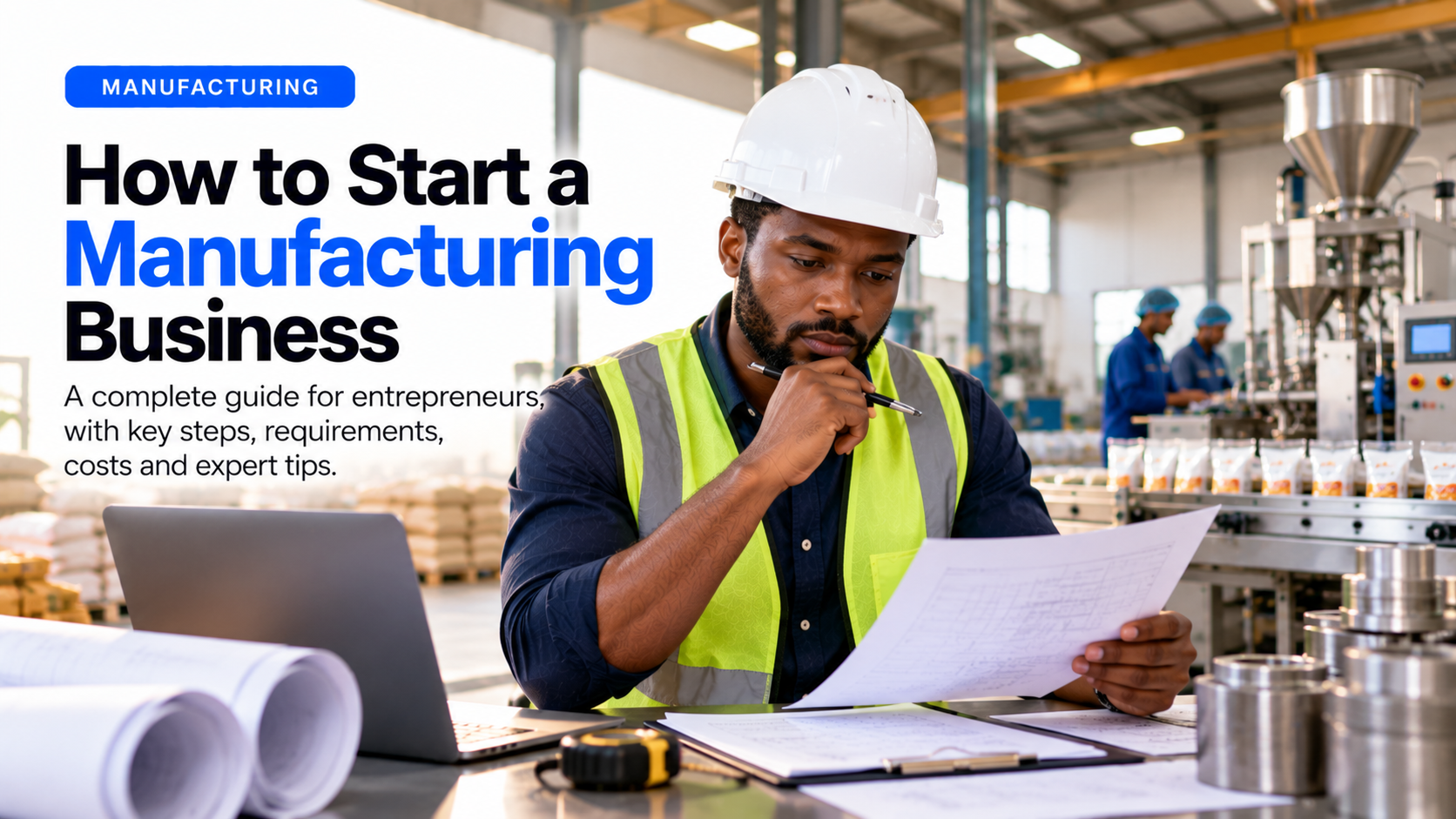
Manufacturing can be one of the most powerful ways to build a scalable business.
Instead of simply buying and reselling products, a manufacturer creates value by transforming raw materials or components into products that customers are willing to pay for.
Around the world, opportunities exist in food processing, packaging, building materials, household products, textiles, plastics, agricultural processing and many other industries.
But manufacturing is also capital-intensive and operationally demanding.
A common mistake is to start with the machinery:
"I need a factory. How much does the machine cost?"
A better starting point is:
"What product can I produce profitably, who will buy it, and what would it take to serve that market competitively?"
This guide explains how to evaluate, establish and grow a manufacturing business.
What Is a Manufacturing Business?
A manufacturing business converts raw materials, components or other inputs into finished or semi-finished products.
Examples include:
Rice milling
Flour production
Soap manufacturing
Paint production
Furniture manufacturing
Plastic products
Packaged foods
Building materials
Garments
Agricultural processing
Packaging materials
Manufacturing can range from a small workshop producing a few hundred units per day to a large industrial facility producing thousands of tonnes annually.
The principles, however, remain similar:
Source inputs → transform them → control quality → sell the finished product profitably.
Why Start a Manufacturing Business?
Manufacturing has several potential advantages.
- Value addition
Instead of selling raw materials, you transform them into higher-value products.
For example:
Raw agricultural commodity → processed food product → packaged branded product
Each stage can potentially create additional value.
- Greater control
Manufacturing can give you more control over:
Product quality
Packaging
Production volume
Product specifications
Pricing
Supply
- Scalability
Once you have a proven product and market, production capacity can potentially be expanded.
- Stronger barriers to entry
A manufacturing business may require:
Equipment
Technical knowledge
Production facilities
Supplier relationships
Quality systems
Distribution networks
These can make it harder for competitors to enter than a simple trading business.
But these same requirements also make manufacturing more difficult to execute.
Step 1: Choose the Right Product
The first major decision is what to manufacture.
Don't choose a product simply because you can buy the machinery.
Start with the market.
Ask:
What problem does the product solve?
Who buys it?
How frequently do they buy?
How much are they willing to pay?
What alternatives exist?
Who are the existing manufacturers?
What makes your product competitive?
Look for products with:
Consistent demand
Reasonable margins
Reliable raw materials
Manageable production requirements
Opportunities for differentiation
A realistic route to customers
A product that is easy to manufacture but difficult to sell is not necessarily a good manufacturing opportunity.
Step 2: Study the Market
Before investing in machinery, understand the market.
Research:
Market size
How many potential customers exist?
Demand
How much of the product is being consumed?
Competition
Who currently supplies the market?
Pricing
What are comparable products selling for?
Customer preferences
What matters most to buyers?
It could be:
Price
Quality
Packaging
Availability
Brand
Delivery speed
Product specifications
Distribution
How does the product reach customers?
For consumer products, this might involve:
Manufacturer → Distributor → Wholesaler → Retailer → Consumer
For industrial products, it may be:
Manufacturer → Corporate/Industrial Customer
Understanding the distribution structure is critical because your product economics may depend heavily on how many intermediaries stand between you and the final customer.
Step 3: Validate Demand Before Building the Factory
This is one of the most important principles in manufacturing:
Don't confuse production capacity with market demand.
A machine may be capable of producing 10,000 units per day.
That doesn't mean customers will buy 10,000 units per day.
Before committing significant capital, consider testing the market through:
Small-scale production
Contract manufacturing
Pilot batches
Samples
Pre-orders
Distributor discussions
Customer interviews
Institutional buyers
Existing product sales
The goal is to obtain evidence that customers will actually buy.
Step 4: Determine Your Production Process
Once you understand the product and market, map the production process.
For example:
Raw materials → Processing → Mixing → Forming → Drying → Packaging → Storage → Distribution
The exact process depends on the industry.
Document:
Raw materials
Production stages
Machinery
Labour
Utilities
Production time
Waste
Quality-control points
Packaging
Storage requirements
This allows you to understand what the factory actually needs.
Step 5: Select the Right Machinery
Machinery is often one of the largest investments in a manufacturing business.
Don't choose equipment based solely on:
Lowest price
Highest capacity
Manufacturer claims
Consider:
Capacity
How much can it realistically produce?
Product quality
Will it produce the required specification consistently?
Energy consumption
How much electricity, gas, fuel or other energy does it require?
Maintenance
Are spare parts available?
Can technicians service it locally?
Automation
How much labour does it require?
Flexibility
Can it produce multiple products or sizes?
Supplier support
Does the equipment supplier provide installation, training and after-sales support?
Don't Buy More Capacity Than You Need
One of the most expensive manufacturing mistakes is overcapacity.
Suppose your market can realistically absorb 2 tonnes per day.
Buying equipment designed for 20 tonnes per day may look impressive, but the unused capacity still costs money.
You have paid for:
Machinery
Installation
Factory space
Energy infrastructure
Maintenance
Labour
Financing
Yet most of the equipment sits idle.
A better strategy is often:
Start with realistic capacity → prove demand → increase capacity as sales grow.
There are exceptions, particularly where economies of scale make larger capacity economically necessary, but the decision should be supported by the numbers.
Step 6: Choose the Location
Location can significantly affect manufacturing economics.
Consider:
Access to raw materials
Proximity to customers
Transportation costs
Electricity
Water
Gas or other energy sources
Labour availability
Security
Road access
Land and building costs
Regulatory requirements
Waste disposal
Storage
A cheap factory far from suppliers and customers may ultimately be more expensive than a more expensive facility in a strategic location.
Step 7: Calculate the Total Startup Cost
Don't calculate startup costs by looking only at machinery.
Your capital expenditure may include:
Facility
Land
Building
Renovation
Factory layout
Warehouses
Machinery
Main production equipment
Supporting equipment
Installation
Commissioning
Utilities
Generator
Solar or other energy systems
Transformers
Water systems
Compressors
Boilers
Other equipment
Laboratory equipment
Weighing equipment
Packaging equipment
Material-handling equipment
Vehicles
Pre-operational expenses
Registration
Licensing
Professional fees
Staff recruitment
Training
Testing
Initial marketing
And then there is something many entrepreneurs underestimate:
Working capital.
Working Capital Can Make or Break a Factory
Imagine you spend $1 million establishing a factory.
The factory is complete.
The machines work.
But you don't have enough money to purchase raw materials, pay workers or distribute products.
The factory cannot operate properly.
Working capital may be needed for:
Raw materials
Packaging
Salaries
Utilities
Transportation
Marketing
Inventory
Receivables
A manufacturing project should therefore calculate both:
Capital expenditure + working capital
—not just the machinery cost.
Step 8: Understand Your Unit Economics
Before starting production, know what it costs to produce one unit.
For example:
Product selling price
$10
Variable costs
Raw materials: $3.50 Packaging: $0.80 Direct labour: $0.50 Production energy: $0.40 Distribution: $0.80
Total variable cost: $6
Gross contribution
$10 − $6 = $4
That $4 then contributes toward fixed costs and profit.
You should calculate this at realistic production volumes.
Fixed Costs Matter Too
Manufacturing businesses typically have costs that don't change directly with each unit produced.
Examples:
Rent
Salaries
Insurance
Administration
Security
Maintenance
Depreciation
Certain utilities
If fixed costs are $40,000 per month and your contribution per unit is $4:
Break-even volume = $40,000 ÷ $4
= 10,000 units per month
That means you need to sell approximately 10,000 units just to cover those fixed costs under those assumptions.
This is why understanding unit economics is essential.
Step 9: Build a Reliable Supply Chain
A factory cannot produce without inputs.
Identify:
Primary suppliers
Alternative suppliers
Lead times
Minimum order quantities
Quality standards
Payment terms
Transportation costs
Seasonal fluctuations
Where possible, avoid excessive dependence on a single supplier.
A production line stopping because one supplier failed to deliver can be extremely expensive.
Step 10: Build Quality Control Into the Process
Quality shouldn't be something you check only after production.
It should be built into the manufacturing process.
Depending on the industry, quality control may involve:
Raw-material inspection
Production monitoring
Weight checks
Laboratory testing
Product specifications
Packaging inspection
Batch tracking
Finished-product testing
Consistency matters.
A customer who buys your product today should receive a product of comparable quality the next time.
Step 11: Understand Regulatory Requirements
Manufacturing can involve significant regulatory obligations.
Depending on the product and location, you may need to consider:
Business registration
Product registration or approval
Environmental requirements
Health and safety
Labour regulations
Tax obligations
Factory requirements
Standards and certification
Import requirements for machinery or inputs
The requirements vary considerably by industry and jurisdiction.
Research the requirements before committing major capital.
Step 12: Plan How You Will Sell the Product
A factory doesn't make money because it produces.
It makes money because it sells.
Before establishing production capacity, answer:
How will these products reach customers?
Potential channels include:
Distributors
Wholesalers
Retailers
Supermarkets
Direct sales
E-commerce
Institutional customers
Corporate contracts
Export markets
Agents
For many consumer products, distribution can be just as important as manufacturing.
A superior product sitting inside a warehouse isn't a successful business.
Step 13: Build the Brand
Manufacturing and branding are different capabilities.
You may produce an excellent product but struggle if customers don't recognise or trust it.
Consider:
Brand name
Packaging
Product positioning
Quality
Pricing
Customer experience
Distribution
Marketing
A strong brand can help transform a commodity into a differentiated product.
Step 14: Hire the Right People
Manufacturing requires people with different skills.
Depending on the business, you may need:
Production managers
Machine operators
Technicians
Quality-control personnel
Procurement staff
Warehouse workers
Salespeople
Accountants
Administrative staff
Don't build a factory and assume that buying machinery solves the technical problem.
People operate systems.
Step 15: Create Standard Operating Procedures
As the business grows, you don't want production to depend entirely on the founder.
Document important processes such as:
Production
Cleaning
Maintenance
Quality control
Procurement
Inventory
Safety
Packaging
Dispatch
These procedures create consistency and make training easier.
Common Manufacturing Mistakes
- Buying machinery before proving demand
This is perhaps the biggest mistake.
Market first. Machinery second.
- Overestimating capacity utilisation
Don't assume the factory will operate at 100% capacity from day one.
Build realistic utilisation assumptions.
- Underestimating working capital
A factory needs money to operate between buying inputs and receiving cash from customers.
- Ignoring distribution
Manufacturing without a distribution strategy creates inventory.
- Competing only on price
A cheaper product isn't automatically a better business.
Consider competing through:
Quality
Availability
Packaging
Service
Reliability
Product innovation
- Ignoring energy costs
Energy can significantly affect manufacturing economics, especially where grid electricity is unreliable or expensive.
- Starting too large
Bigger isn't always better.
Start at a scale that the market and economics can support.
- Failing to calculate unit economics
Revenue projections without product-level costs can produce misleading financial projections.
A Simple Manufacturing Feasibility Checklist
Before investing in a factory, answer these questions:
Market
Who will buy the product?
How large is the market?
What are competitors selling?
What price can you realistically charge?
Production
What raw materials are required?
What machinery is needed?
What production capacity is appropriate?
What utilities are required?
Costs
How much is the factory setup?
How much is the machinery?
How much working capital is required?
What is the cost per unit?
Operations
Where will the factory be located?
Who will operate it?
How will quality be controlled?
How will raw materials be sourced?
Sales
Who will distribute the product?
How will you acquire customers?
How quickly can inventory be converted into cash?
Financials
What is the gross margin?
What are the fixed costs?
What is the break-even volume?
How long could it take to recover the investment?
Risk
What happens if sales are lower than expected?
What happens if input costs increase?
What happens if the factory operates below capacity?
What happens if your largest customer leaves?
If you cannot answer these questions, you probably need more analysis before buying the machinery.
Should You Start a Manufacturing Business?
Manufacturing can create substantial value and, when properly executed, can become a highly scalable business.
But it is not simply about owning machines.
A successful manufacturing business requires the combination of:
Demand + Product + Production + Economics + Distribution + Execution.
Get one of these seriously wrong and the entire investment can be affected.
The best manufacturing entrepreneurs don't ask only:
"How much will the factory cost?"
They ask:
"Can I build a product that customers will buy repeatedly at a price that produces an attractive return on the capital invested?"
That is the question your feasibility analysis should help you answer.
Final Thoughts
Manufacturing can be an excellent opportunity for entrepreneurs who are prepared to understand both the market and the operational realities.
But don't fall in love with the factory.
Fall in love with the business economics.
Before spending millions on equipment, determine whether the market, product, production process, costs, distribution strategy and financial returns make sense.
Build the market first. Then build the factory.
LoDuko helps entrepreneurs evaluate business opportunities through a structured business interview and turn their thinking into professional feasibility reports, business plans and pitch decks.
Understand the opportunity before you invest in the infrastructure.
Explore LoDuko →