How to Get the Most Out of Your LoDuko Business Interview
A practical guide to answering the LoDuko business interview so you get more useful, accurate and decision-ready business documents.
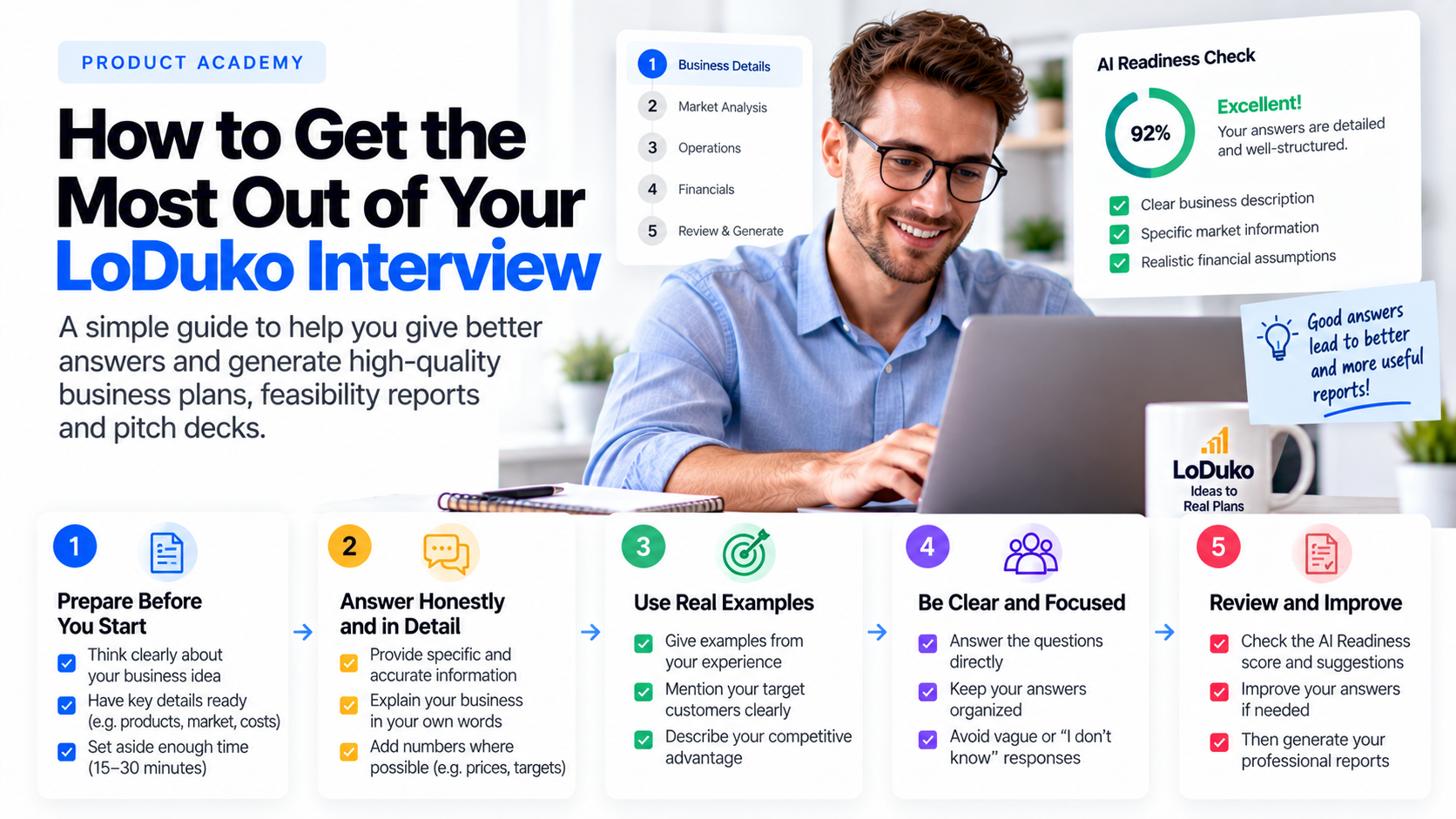
A business plan is only as useful as the thinking behind it.
The same applies to a feasibility report or pitch deck.
If the underlying assumptions are vague, unrealistic or incomplete, even an excellent document may produce weak conclusions.
That is why LoDuko begins with a guided business interview.
Instead of asking you to stare at a blank document and figure out what to write, LoDuko takes you through the important questions about your business idea.
The better you answer those questions, the more useful your final documents can become.
This guide explains how to approach the LoDuko interview strategically.
What Is the LoDuko Business Interview?
The LoDuko Business Interview is a guided process designed to collect the information needed to understand your business idea.
Depending on the product you are creating, the interview explores areas such as:
Business concept
Problem and opportunity
Target customers
Products or services
Market
Competition
Business model
Marketing
Sales
Operations
Resources
Team
Financial assumptions
Risks
Growth plans
Rather than beginning with a blank page, you begin with questions that help structure your thinking.
The objective isn't simply to collect information.
It is to help you think more clearly about the business itself.
Why Your Answers Matter
Imagine two entrepreneurs enter exactly the same business idea into an AI system.
Entrepreneur A writes:
"I want to start a food business selling healthy snacks."
Entrepreneur B provides:
"We will manufacture baked plant-based snacks targeted at health-conscious professionals aged 25–45 in urban markets. The initial products will be sold through direct online orders and selected retail stores. We have identified three competing brands and believe our opportunity is to compete through higher protein content, convenient packaging and a mid-market price."
The second entrepreneur has provided significantly more useful information.
The resulting analysis can therefore be more specific.
This leads to an important principle:
Better business information produces better business analysis.
You Don't Need to Have Everything Figured Out
One of the biggest misconceptions about business planning is that you need to know all the answers before you begin.
You don't.
The purpose of the interview is partly to expose what you don't know.
For example, you may know:
What you want to sell
Who you think your customers are
Roughly how much you want to invest
But you may not know:
How large the market is
What competitors charge
What your realistic sales volume could be
How much working capital you'll need
What your break-even point will be
That's okay.
Don't invent answers simply because you feel you should know them.
Instead, distinguish between:
What you know.
What you estimate.
What you need to research.
That distinction makes your planning more credible.
Before You Start the Interview
Spend a few minutes gathering information.
You may want to have:
Product or service details
Estimated pricing
Target customer information
Competitor names
Supplier information
Startup-cost estimates
Equipment quotations, if applicable
Expected operating expenses
Available capital
Sales assumptions
Existing customer information
Relevant market research
You don't need a huge research report.
Even basic preparation can substantially improve the quality of your answers.
Answer the Question, Not the Question You Wish You Had Been Asked
Suppose the interview asks:
Who is your target customer?
A weak answer might be:
"Everyone."
Almost every business has a target market, even if the potential market is large.
A better answer might identify:
Customer type
Age or life stage where relevant
Location
Business size if B2B
Income or purchasing power where relevant
Need/problem
Buying behaviour
Reason they would choose the product
The goal isn't to make the answer complicated.
It is to make it useful.
Be Specific About the Customer Problem
One of the most important questions in business is:
What problem are you solving?
Avoid describing only the product.
For example:
Weak:
"We sell accounting software."
Stronger:
"We help small businesses replace fragmented spreadsheets with a simpler system for tracking invoices, expenses and cash flow."
The second answer explains the outcome.
A business exists because customers have problems, needs, desires or opportunities.
Make yours clear.
Explain Why Customers Would Choose You
Having a product isn't enough.
Customers already have alternatives.
Your alternatives may include:
Competitors
Substitute products
Existing solutions
Doing the work themselves
Doing nothing
When answering LoDuko's questions, explain:
Why should the customer choose you?
Your answer might involve:
Price
Quality
Convenience
Speed
Location
Expertise
Technology
Customer experience
Distribution
Product features
Reliability
Specialization
Avoid generic claims such as:
"We offer the best quality at the best price."
Explain what actually makes the offer different.
Be Honest About Competition
Don't say:
"There is no competition."
There almost always is.
If there are no direct competitors, customers may already be solving the problem another way.
For example, a new project-management platform isn't only competing against other project-management platforms.
It may also compete against:
Spreadsheets
Messaging apps
Paper
Existing internal processes
Understanding alternatives creates a more realistic business strategy.
Give Realistic Pricing Information
If you already have a price, provide it.
If you don't, provide a reasonable estimate and indicate that it is an assumption.
For example:
"We expect to sell each unit for approximately $15 based on competitor pricing, but this will be validated through market testing."
That's much better than pretending the price is certain.
Pricing affects:
Revenue
Gross margin
Break-even
Customer acquisition
Positioning
Funding requirements
So it deserves careful thought.
Think in Units, Not Just Revenue
If you're selling physical products, don't simply say:
"We expect $100,000 in monthly sales."
Explain how you expect to reach it.
For example:
10,000 units × $10 average selling price = $100,000 revenue
Now the assumption can be tested.
Can you actually produce 10,000 units?
Can you sell them?
Do customers exist?
Do distributors have enough capacity?
Can your supply chain support it?
Unit-based thinking makes business assumptions easier to evaluate.
Distinguish Revenue From Profit
Revenue is not profit.
If your business generates $100,000 in sales but spends $80,000 producing and delivering those sales, the economics are very different from a business spending $40,000.
When answering financial questions, think about:
Revenue
Cost of goods/services
Gross profit
Operating expenses
Taxes where applicable
Financing costs
Net profit
Cash flow
This helps create a more realistic picture.
Think Carefully About Startup Costs
Don't estimate startup capital using only the obvious expenses.
Consider:
Assets
Equipment
Technology
Furniture
Vehicles
Tools
Setup
Facility preparation
Installation
Professional services
Licenses and approvals where applicable
Branding
Initial operating requirements
Inventory
Marketing
Staff
Rent
Utilities
Working capital
Money required to keep operating while the business establishes itself.
A business can have enough money to open and still run out of cash shortly afterward.
Use Evidence Where Possible
There is a major difference between:
"I think customers will buy this."
and:
"We surveyed 150 potential customers and 62% indicated that they would consider buying at our proposed price."
The second provides evidence.
Not every business has formal research.
But evidence can come from:
Customer interviews
Surveys
Existing sales
Competitor prices
Supplier quotations
Industry data
Search behaviour
Pre-orders
Pilot projects
Test campaigns
Existing customer feedback
When you have evidence, provide it.
Don't Hide Uncertainty
A good business analysis should identify uncertainty rather than hide it.
For example:
"We expect to acquire 500 customers in year one, but this assumption has not yet been validated."
This is more useful than:
"We will acquire 500 customers."
The first statement tells you where further validation is needed.
Good planning doesn't eliminate uncertainty.
It makes uncertainty visible.
Think About Risks
Every business has risks.
Consider:
Market risk
What if demand is lower than expected?
Competitive risk
What if a stronger competitor enters the market?
Financial risk
What if costs increase or customers pay late?
Operational risk
What if equipment fails?
Supply-chain risk
What if a critical supplier becomes unavailable?
Regulatory risk
What if regulations change?
People risk
What if a key employee leaves?
Technology risk
What if technology becomes obsolete or fails?
Don't list risks just to complete a section.
Think about:
Probability × Impact × Response
What could happen?
How likely is it?
How damaging would it be?
What can you do about it?
When You Don't Know, Say So
Sometimes the correct answer is:
"I don't know yet."
That's useful information.
You can then investigate the issue.
For example:
"We haven't determined the exact equipment required."
This tells you that technical research is needed.
An invented answer creates false confidence.
An identified knowledge gap creates an opportunity for better research.
Use Consistent Assumptions
Your answers should make sense together.
For example, suppose you say:
Selling price: $20
Monthly sales: 10,000 units
Production capacity: 2,000 units
Target market: 500 customers
There may be inconsistencies.
The interview is an opportunity to notice them.
Check whether your assumptions about:
Price
Volume
Capacity
Customers
Marketing
Staffing
Investment
Costs
tell a coherent story.
Think About the Business as a System
Don't answer each question in isolation.
Your business has interconnected parts.
For example:
More customers → more sales → more production → more inventory → more working capital → potentially more employees → higher operating costs
A decision in one area can affect several others.
This is why structured business planning is valuable.
It forces you to consider the connections.
If You Already Have a Business, Use Actual Data
Existing businesses have an advantage.
You don't need to rely entirely on projections.
Where available, provide actual:
Revenue
Sales volume
Customer numbers
Costs
Margins
Repeat purchases
Conversion rates
Operating expenses
Inventory
Cash flow
Actual data can make your business analysis much more grounded.
Even imperfect historical data is often more useful than unsupported assumptions.
If You're Starting From Scratch, Use Conservative Assumptions
A new business has little or no historical data.
That means projections are inherently uncertain.
Avoid building a model around the assumption that everything will go perfectly.
Instead, consider:
Conservative scenario
Lower sales, higher costs.
Base scenario
Your most reasonable expectation.
Optimistic scenario
Strong execution and favourable market conditions.
This helps you understand how sensitive the business is to changes in assumptions.
Don't Try to Sound Like an Expert
Your answers don't need corporate jargon.
Write naturally.
Instead of:
"We intend to leverage an omnichannel ecosystem to optimize customer acquisition."
You can say:
"We will sell through our website, selected retailers and distributors."
Clear information is more valuable than impressive language.
LoDuko can help structure and present your business information professionally.
Your job is to provide the underlying thinking.
Use the Interview to Discover Weaknesses
One of the most valuable benefits of the interview is that it can reveal questions you haven't considered.
For example, you may realize:
"I know what I want to sell, but I haven't identified my primary customer."
Or:
"I know my startup cost, but I haven't calculated working capital."
Or:
"I know my product, but I haven't researched competitors."
These aren't failures.
They are discoveries.
A good planning process should expose gaps before they become expensive mistakes.
Don't Rush Through Difficult Questions
Some questions are easy:
What are you selling?
Others require deeper thinking:
What makes your business defensible?
Why will customers switch from existing alternatives?
What happens if sales are 30% below your forecast?
How will you acquire customers?
What is your biggest operational risk?
Don't rush these questions.
They are often among the most valuable parts of the process.
Use the "Evidence, Assumption, Unknown" Framework
For difficult questions, classify your answer mentally as one of three things.
Evidence
Something supported by actual information.
Example:
"We currently have 120 paying customers."
Assumption
Something you reasonably expect but haven't proven.
Example:
"We expect 20% of customers to purchase again each month."
Unknown
Something you haven't established yet.
Example:
"We haven't determined the optimal distribution model."
This simple framework prevents false certainty.
After the Interview: Review the Output
When your document is generated, don't simply download it and forget about it.
Read it critically.
Ask:
Does it accurately represent my business?
Are the assumptions realistic?
Are there contradictions?
Are the financial projections consistent?
Are the risks properly identified?
Does the strategy make sense?
What information is missing?
What should I validate next?
The document should become a decision-making tool, not merely a polished file.
A Business Plan Is Not the Business
This distinction matters.
A beautifully written business plan cannot compensate for:
Weak demand
Poor economics
Bad execution
Insufficient capital
Poor management
Weak distribution
The purpose of planning is not to make the business look good.
It is to help you understand whether the business can work and how you might make it work.
The Three LoDuko Outputs
The information you provide through the guided business interview can support different business needs.
Feasibility Report
Focuses on:
Should this business be pursued?
It helps evaluate the opportunity, market, economics, operational requirements and risks.
Business Plan
Focuses on:
How will we build and operate this business?
It provides a structured roadmap for execution.
Pitch Deck
Focuses on:
How do we communicate the opportunity clearly to investors, partners or other stakeholders?
Each serves a different purpose.
And because the underlying business information is structured, you don't need to rebuild your thinking from scratch every time.
The "Answer Once" Advantage
This is one of the fundamental ideas behind LoDuko.
Traditional business-document creation can feel like starting over repeatedly.
First you create a business plan.
Then someone asks for a feasibility study.
Then an investor asks for a pitch deck.
Then a lender asks for financial information.
You may end up rewriting the same information again and again.
LoDuko's approach is different:
Answer once. Build from there.
The structured information from your business interview becomes the foundation for multiple professional outputs.
How to Get Better Results: The Quick Formula
Before submitting an answer, ask yourself:
Is it specific?
Is it realistic?
Is it supported by evidence?
Is it clearly identified as an assumption if uncertain?
Does it agree with my other answers?
If the answer to these questions is yes, you're probably giving LoDuko useful information.
Your Pre-Interview Checklist
Before starting, try to have these available:
[ ] Business idea clearly defined
[ ] Product/service description
[ ] Target customer
[ ] Customer problem
[ ] Competitors or alternatives
[ ] Proposed pricing
[ ] Sales channels
[ ] Marketing approach
[ ] Startup-cost estimates
[ ] Operating-cost estimates
[ ] Revenue assumptions
[ ] Available capital
[ ] Supplier information
[ ] Operational requirements
[ ] Team information
[ ] Key risks
[ ] Growth objectives
You don't need every item.
The interview will help identify what still needs to be developed.
Final Thoughts
The LoDuko Business Interview is not an exam.
There are no points for sounding sophisticated.
The goal is to provide the clearest and most honest picture of your business that you can.
Be specific when you know. Be transparent when you're estimating. Say when you don't know. Use evidence whenever possible. Think about how your assumptions connect.
The better you understand your business, the more useful your business documents become.
And sometimes the most valuable result isn't the document itself.
It is the better business thinking that happened while creating it.
Plan. Validate. Launch. With confidence.
Explore LoDuko at loduko.com.