The State of Entrepreneurship in Africa: Opportunities, Challenges and Trends
A practical look at the forces shaping entrepreneurship across Africa—and what they mean for founders building businesses on the continent.
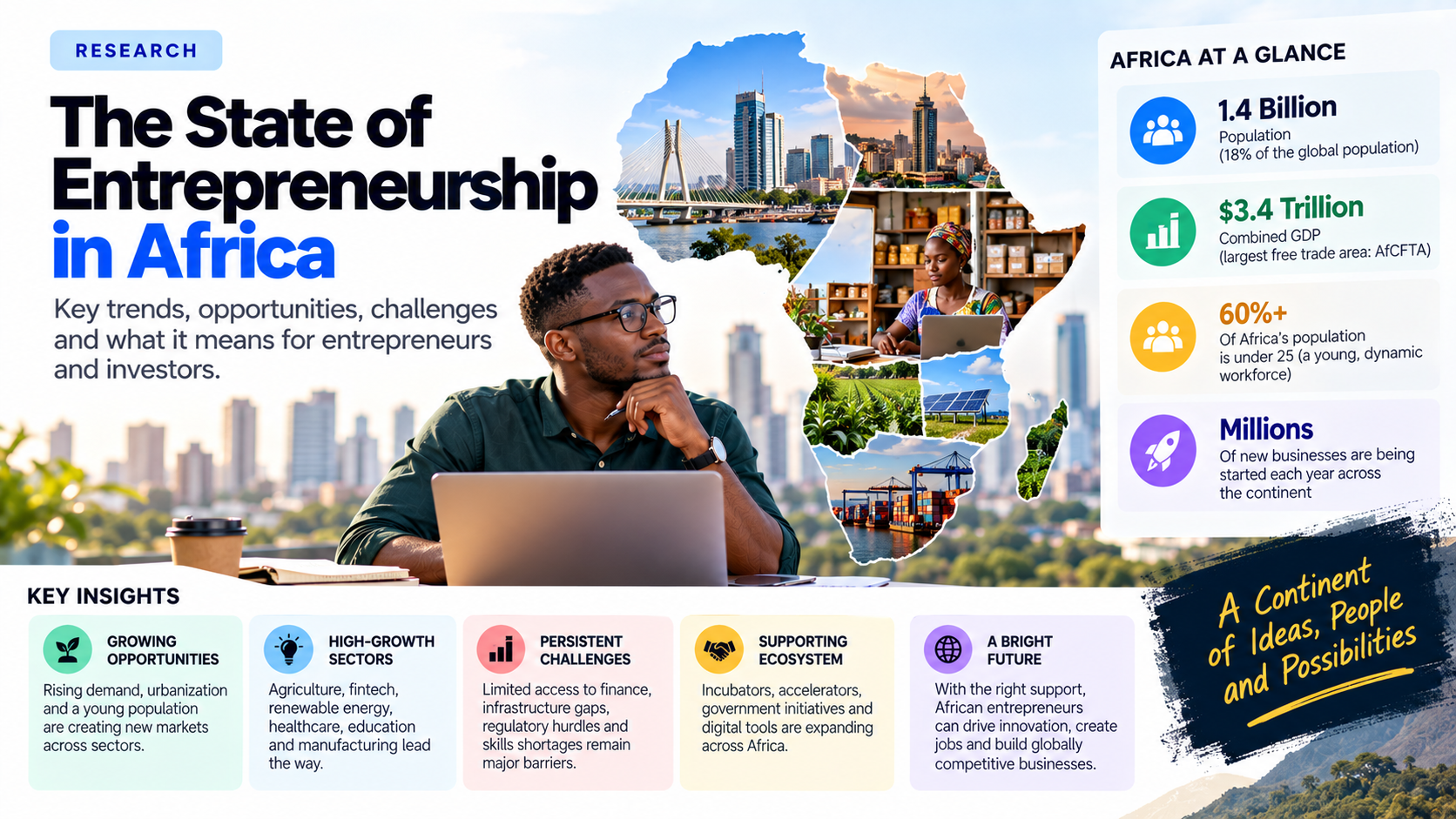
Africa's entrepreneurial landscape is changing rapidly.
Across the continent, entrepreneurs are building businesses in agriculture, manufacturing, financial services, technology, healthcare, logistics, education, energy, retail and hundreds of other sectors.
Some are building venture-backed technology companies.
Others are building small manufacturing businesses, farms, food-processing operations, retail businesses and professional-service firms.
These businesses are very different.
But they operate within many of the same structural realities:
A young and growing population
Increasing urbanization
Expanding digital adoption
Large unmet consumer needs
Infrastructure gaps
Limited access to capital
Informal markets
Fragmented distribution
Currency and macroeconomic volatility
Significant differences between countries
For entrepreneurs, this creates a paradox.
Africa can be difficult to build in—but those same difficulties often create some of the biggest opportunities.
Africa's Entrepreneurial Opportunity
Africa should not be treated as a single market.
The continent consists of dozens of countries with different:
Languages
Regulations
Currencies
Consumer behaviours
Income levels
Infrastructure
Political environments
Financial systems
Trade relationships
A business that succeeds in one country may struggle in another.
So the first principle for entrepreneurs is:
Think African, but validate locally.
A large continental opportunity is useful only if you can identify a specific customer, problem and market that you can actually serve.
- Africa Has a Large and Growing Consumer Market
One of the continent's major long-term opportunities is demographic.
Africa has a relatively young population, and many countries are experiencing rapid population growth and urbanization.
That creates growing demand for:
Food
Housing
Transportation
Education
Healthcare
Financial services
Consumer products
Entertainment
Digital services
Energy
Logistics
But population size alone doesn't create a business opportunity.
The real question is:
What are people increasingly willing and able to pay for?
Entrepreneurs need to connect demographic trends with purchasing behaviour.
- Urbanization Is Creating New Markets
As cities grow, consumers increasingly need products and services that make urban life easier.
Opportunities can emerge around:
Food distribution
Affordable housing
Logistics
Mobility
Waste management
Retail
Convenience services
Childcare
Education
Healthcare
Entertainment
Business services
Urbanization also changes how products are distributed.
A business that once relied on informal local markets may eventually need:
Warehousing
Distribution networks
Retail partnerships
Digital ordering
Delivery infrastructure
This creates opportunities for businesses that solve the infrastructure around consumption—not just consumption itself.
- Digital Adoption Is Changing How Businesses Operate
Digital tools are becoming increasingly important to African businesses.
Entrepreneurs can now use technology for:
Payments
Marketing
Customer acquisition
Accounting
Inventory
Communication
E-commerce
Customer service
Data analysis
Business planning
Remote work
Automation
This creates an important opportunity.
Technology doesn't only create technology companies.
A traditional business can use technology to become more efficient and competitive.
A small manufacturer can use digital inventory management.
A farmer can use digital marketplaces.
A retailer can accept digital payments.
A professional can sell services internationally.
The opportunity is therefore broader than "build an app."
It is:
Use technology to solve expensive problems.
- Financial Inclusion Remains a Major Opportunity
Many African consumers and businesses have historically had limited access to traditional financial services.
Digital financial infrastructure has expanded the possibilities for:
Payments
Digital banking
Lending
Insurance
Savings
Merchant services
Cross-border transactions
This has created opportunities for financial-technology businesses.
But fintech isn't the only beneficiary.
Better financial infrastructure can also enable businesses in:
Commerce
Agriculture
Logistics
Education
Healthcare
Professional services
The broader opportunity is reducing friction in how people and businesses move, save and access money.
- Agriculture Is Bigger Than Farming
Agriculture remains one of Africa's most important economic sectors.
But many entrepreneurs make the mistake of thinking only about primary production.
The larger opportunity lies across the agricultural value chain.
For example:
Inputs → Production → Aggregation → Storage → Processing → Packaging → Distribution → Retail
Opportunities can therefore exist in:
Seeds
Fertilizer
Farm equipment
Irrigation
Farm services
Aggregation
Cold storage
Warehousing
Processing
Packaging
Logistics
Agricultural finance
Market access
The question isn't simply:
"What crop can I grow?"
It is:
"Where is value being lost, and how can I capture some of it?"
- Food Processing Has Significant Potential
Africa produces enormous quantities of agricultural commodities while importing significant amounts of processed food and other products.
This creates opportunities for entrepreneurs who can move from:
Raw materials → Value-added products
Examples include:
Grain processing
Fruit processing
Vegetable processing
Animal feed
Dairy products
Snacks
Beverages
Spices
Oils
Flour
Packaged foods
The opportunity is not simply producing more.
It is improving:
Processing
Quality
Packaging
Shelf life
Distribution
Branding
Consistency
Value addition can transform an agricultural commodity into a scalable consumer business.
- Manufacturing Opportunity Is Increasing
Manufacturing remains difficult in many African markets.
Challenges include:
Energy costs
Infrastructure
Access to machinery
Financing
Imported inputs
Logistics
Technical skills
But these challenges also indicate unmet demand.
Businesses can potentially compete by producing locally what is currently:
Imported
Expensive
Difficult to obtain
Poorly distributed
Inconsistently supplied
Potential areas include:
Food products
Packaging
Building materials
Household products
Personal-care products
Agricultural inputs
Furniture
Textiles
Light industrial products
The key is not simply:
"What can we manufacture?"
It is:
"What product has sufficient demand and attractive economics to justify local production?"
- Energy Is a Business Opportunity
Reliable energy remains a major challenge across many African markets.
That creates opportunities in:
Solar
Battery storage
Energy-as-a-service
Mini-grids
Energy-efficient equipment
Backup power
Industrial energy solutions
Productive-use energy systems
Energy businesses can also unlock other businesses.
A reliable energy solution can improve the economics of:
Cold storage
Food processing
Manufacturing
Agriculture
Retail
Telecommunications
This creates an important distinction:
Some businesses sell energy. Others become possible because energy becomes more reliable.
- Logistics and Distribution Are Major Opportunities
Africa's geography and infrastructure create significant logistics challenges.
Moving goods from:
Producer → Warehouse → Distributor → Retailer → Consumer
can be expensive and inefficient.
Entrepreneurs can create value through:
Transportation
Warehousing
Fulfillment
Last-mile delivery
Cold chains
Route optimization
Inventory management
B2B distribution
Distribution is especially important for consumer-product companies.
A great product sitting in a warehouse isn't a successful business.
- Education and Skills Are Growing Markets
Africa's young population creates enormous demand for education and employable skills.
Opportunities exist in:
Vocational training
Technology education
Business education
Professional development
Language learning
Online learning
Test preparation
Career services
Corporate training
The strongest opportunities often connect education to a measurable outcome.
For example:
Learn skill → demonstrate competence → obtain work → increase income
The closer a product is to a valuable outcome, the easier it may be to communicate its value.
- Healthcare Creates Both Social and Commercial Opportunities
Healthcare demand is increasing as populations grow and incomes change.
Opportunities can emerge around:
Primary healthcare
Diagnostics
Pharmacies
Health technology
Medical logistics
Healthcare administration
Preventive care
Specialist services
Affordable healthcare products
However, healthcare is highly regulated.
Entrepreneurs entering the sector need to understand applicable laws, professional requirements, licensing and safety standards in their target markets.
- The Informal Economy Is a Huge Market
One of the most important characteristics of many African economies is the size of informal commerce.
Millions of people operate businesses without the structures associated with formal corporations.
These entrepreneurs may need:
Working capital
Bookkeeping
Inventory management
Payments
Business education
Procurement
Market access
Digital tools
Insurance
Logistics
This creates an enormous potential market.
But serving informal businesses requires understanding how they actually operate.
A product designed for a large corporation may fail completely when offered to a small trader.
The entrepreneur must design around:
real behaviour—not assumptions.
- Access to Capital Remains a Major Challenge
One of the biggest constraints for African entrepreneurs is financing.
Potential sources include:
Personal savings
Friends and family
Business revenue
Bank loans
Microfinance
Government programmes
Grants
Angel investors
Venture capital
Crowdfunding
Strategic investors
Supplier credit
Customer prepayments
But funding should not be the starting point.
The stronger sequence is:
Problem → Customer → Business model → Validation → Economics → Funding
not:
Idea → Funding → Hope
- Venture Capital Is Not the Answer for Every Business
Technology and venture capital receive significant attention in discussions about African entrepreneurship.
But most businesses are not designed to become venture-backed companies.
A profitable:
Manufacturing company
Distribution company
Food business
Professional-services firm
Agricultural business
Retail business
can be an excellent company without raising venture capital.
Entrepreneurs should choose a financing model that matches the business.
A company designed to grow 20% annually does not necessarily need venture capital.
A company targeting rapid regional or global expansion might.
- Cross-Border Trade Creates Opportunity—and Complexity
A successful business in one African market may eventually have opportunities in neighbouring markets.
Regional trade can create larger markets for:
Food
Consumer products
Manufacturing
Services
Technology
Professional expertise
But cross-border expansion introduces additional complexity:
Customs
Taxes
Standards
Currency
Logistics
Regulations
Distribution
Local competition
Don't assume that entering another country is simply a matter of shipping products there.
Each new market requires validation.
- Local Knowledge Is a Competitive Advantage
Global businesses entering African markets may have:
Capital
Technology
Expertise
But local entrepreneurs often have something equally valuable:
context.
They understand:
Customers
Language
Culture
Distribution
Informal networks
Local purchasing behaviour
Infrastructure
Business relationships
Entrepreneurs should not underestimate the value of local knowledge.
But local knowledge alone isn't enough.
It becomes powerful when combined with:
professional execution + data + technology + disciplined management.
- The Biggest Opportunity May Be Solving Ordinary Problems
Entrepreneurship discussions sometimes focus too much on futuristic ideas.
But many valuable businesses solve ordinary problems:
Food is expensive.
Delivery is unreliable.
Farmers struggle to reach markets.
Businesses can't access financing.
Customers can't find trusted services.
Small businesses don't keep proper records.
Manufacturers struggle with inputs.
Companies lose money through inefficiency.
Consumers have limited access to quality products.
These aren't glamorous problems.
But they can be commercially valuable.
A useful entrepreneurial question is:
What problem do people complain about repeatedly—and already spend money trying to solve?
- AI Is Becoming a Business Multiplier
Artificial intelligence is creating new possibilities for African entrepreneurs.
Small businesses can increasingly use AI for:
Market research
Content creation
Customer support
Business planning
Data analysis
Sales
Marketing
Product development
Administrative work
Training
Research
Automation
This lowers the cost of accessing capabilities that were previously available mainly to larger companies.
But AI doesn't remove the need for:
Market knowledge
Execution
Capital
Distribution
Customer relationships
Product quality
AI can make a capable entrepreneur more productive.
It does not automatically make a weak business viable.
- The Biggest Challenge: Execution
Africa has no shortage of business ideas.
The difficult part is execution.
Entrepreneurs must navigate:
Uncertain markets
Infrastructure problems
Limited capital
Competition
Hiring
Regulation
Supply chains
Cash flow
Customer acquisition
This makes operational discipline particularly important.
A strong entrepreneur must be able to:
Plan → Test → Measure → Adapt → Execute
repeatedly.
- The Most Important Business Skill Is Learning
Markets change.
Technology changes.
Customers change.
Regulations change.
Competitors change.
The entrepreneur therefore needs the ability to learn faster than the business environment changes.
That means developing habits around:
Customer feedback
Market research
Financial analysis
Competitor monitoring
Experimentation
Continuous education
Data-driven decisions
The best entrepreneurs aren't necessarily those who know everything.
They are often those who can find out what they don't know quickly.
The Major Trends Entrepreneurs Should Watch
Several long-term trends deserve attention.
- Digital commerce
More businesses and consumers are moving transactions online.
- Financial technology
Digital payments and financial infrastructure continue to reshape commerce.
- Artificial intelligence
AI is lowering the cost of information, analysis and content production.
- Local manufacturing
Supply-chain disruptions and import costs can create opportunities for local production.
- Agricultural value addition
Processing and distribution can create more value than primary production alone.
- Renewable energy
Solar, storage and distributed energy can address major infrastructure gaps.
- Urban consumption
Growing cities create demand for convenience, housing, mobility, food and services.
- Skills development
Businesses and workers increasingly need new digital and technical capabilities.
- Regional markets
Entrepreneurs with successful local businesses may increasingly look toward neighbouring markets.
- Business digitization
Traditional businesses are increasingly adopting software, digital payments, analytics and automation.
What African Entrepreneurs Should Avoid
- Copying foreign business models blindly
A model that works in one market may fail because the underlying infrastructure or customer behaviour is different.
- Chasing trends without customers
AI, fintech and other trends can create opportunities.
But customers still need to pay.
- Building before validating
Expensive infrastructure should follow credible demand.
- Ignoring distribution
A great product that customers cannot easily access will struggle.
- Underestimating working capital
Growth consumes cash.
- Expanding too early
A business should strengthen its model before adding unnecessary complexity.
- Confusing funding with success
Raising money is not the same as building a valuable business.
- Ignoring financial management
Revenue without cash-flow discipline can destroy a business.
A Framework for Evaluating Opportunities
When considering a business opportunity, ask these ten questions:
What problem are we solving?
Who has the problem?
How painful or valuable is it?
How are customers solving it today?
How much are they willing to pay?
How large is the addressable market?
Can we reach customers efficiently?
Can we deliver the product profitably?
What could prevent the business from succeeding?
Why are we capable of winning?
If you cannot answer these questions, the opportunity may require more research before significant investment.
Africa's Opportunity Is Not One Opportunity
The phrase "African market" can be misleading.
A founder building a food-processing business in one country has a very different opportunity from a software company selling across multiple countries.
A business targeting wealthy urban consumers has a different model from one serving low-income rural customers.
A manufacturing company has different capital requirements from a digital service.
So entrepreneurs should move through three levels of thinking:
Africa → Country → Specific Market
Then go even deeper:
Market → Customer Segment → Problem → Business Model
That is where a broad opportunity becomes an actionable business.
What This Means for Entrepreneurs
The African entrepreneurial opportunity is substantial.
But opportunity should not be confused with guaranteed success.
The continent's challenges create demand for solutions.
Its demographic changes create new markets.
Its digital transformation creates new tools.
Its infrastructure gaps create opportunities for businesses willing to solve difficult problems.
But successful entrepreneurs still need to do the fundamentals:
Understand the customer.
Validate demand.
Build sound economics.
Manage cash.
Create reliable operations.
Build distribution.
Hire well.
Measure performance.
Adapt quickly.
The fundamentals remain the fundamentals.
Final Thoughts
Africa's next generation of businesses will not come from one sector.
They will emerge from entrepreneurs solving problems across agriculture, manufacturing, technology, finance, healthcare, education, energy, logistics, consumer products and services.
Some will build billion-dollar technology companies.
Others will build highly profitable regional businesses.
Others will create factories, farms, distribution networks and service companies that employ thousands of people.
There is no single definition of entrepreneurial success.
The opportunity is to identify a real problem, understand the market and build a business capable of creating and capturing value.
The biggest opportunity isn't simply that Africa has problems.
It is that millions of people are already spending money trying to solve them.
The entrepreneurs who understand those problems deeply—and build sustainable businesses around solving them—will shape the next chapter of African commerce.
From Opportunity to Business Case With LoDuko
A promising market opportunity is only the beginning.
Before investing your money, you need to understand the customer, market, competition, business model, operations, financial requirements, risks and growth potential.
LoDuko helps entrepreneurs work through these questions using a guided business interview and turn their thinking into professional business documents.
Create a Feasibility Report, Business Plan or Pitch Deck from structured business information—without starting from a blank page each time.
Plan. Validate. Launch. With confidence.
Explore LoDuko at loduko.com.