How to Build a Sales Strategy for a Small Business
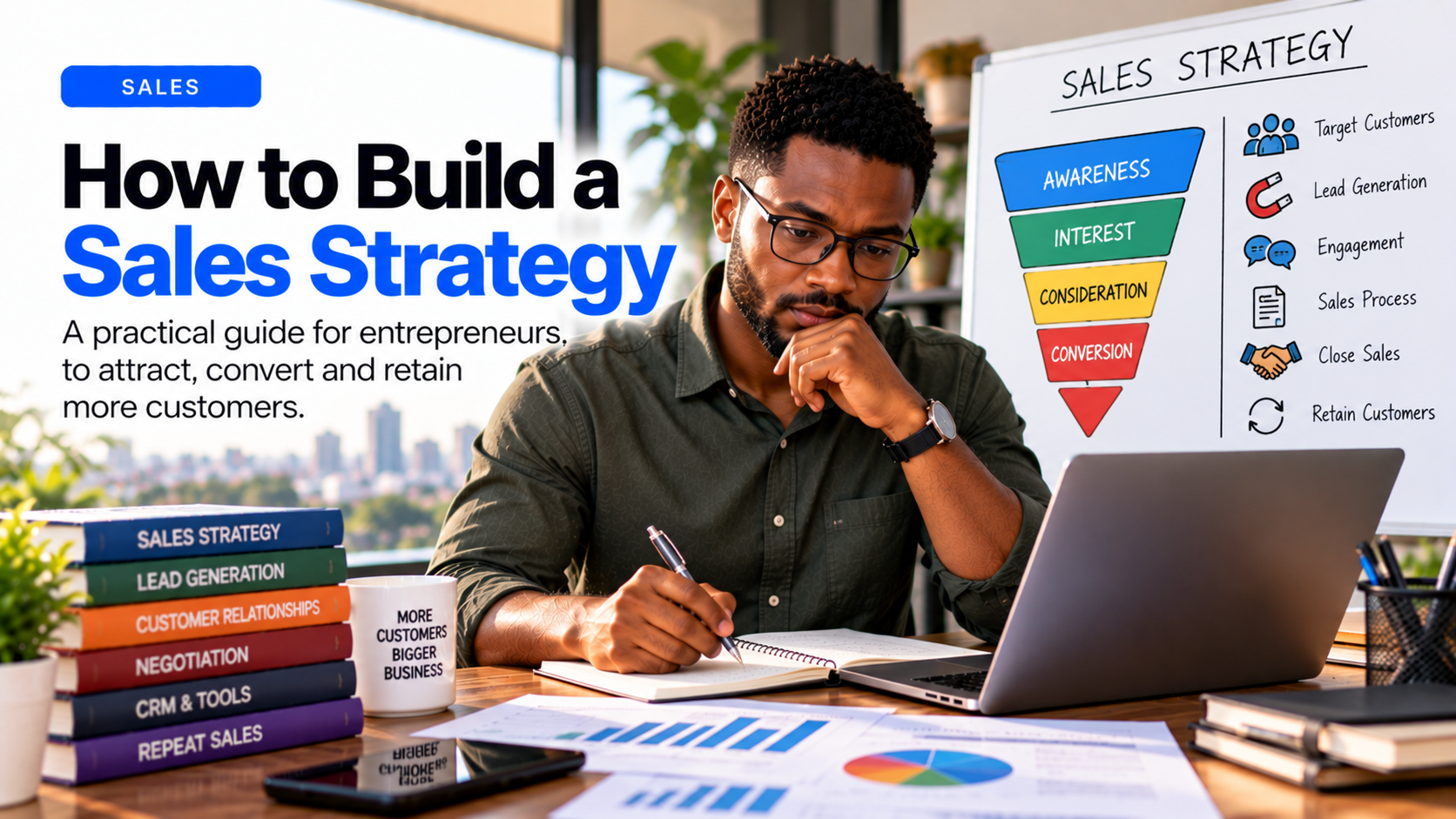
A business can have a great product, strong branding and an excellent marketing campaign—and still struggle to make money.
Why?
Because attention is not sales.
Marketing helps people discover and consider your business. Sales turns that interest into revenue.
A sales strategy gives your business a structured way to find potential customers, communicate value, overcome objections, close deals and generate repeat business.
For a small business, this doesn't have to mean hiring a large sales team or building a complicated CRM.
It means answering a few fundamental questions:
Who are we selling to? What are we selling them? Why should they buy from us? How will we reach them? And how will we consistently turn prospects into customers?
This guide explains how to build a practical sales strategy for a small business.
What Is a Sales Strategy?
A sales strategy is a structured plan for generating revenue from your target customers.
It defines:
Who you sell to
What you sell
Where you find customers
How you approach them
How you present your offer
How you handle objections
How you close sales
How you follow up
How you retain customers
How you measure performance
In simple terms:
A sales strategy explains how your business turns potential demand into actual revenue.
Sales vs Marketing: What's the Difference?
Marketing and sales are closely connected, but they aren't the same.
Marketing
Marketing creates awareness, interest and demand.
It asks:
"How do we get the right people interested?"
Sales
Sales converts that interest into customers.
It asks:
"How do we get the interested person to buy?"
For example:
A potential customer sees your Instagram post.
Marketing got their attention.
They visit your website and request information.
Marketing helped generate the lead.
You call them, understand their needs, answer their questions and make an offer.
Sales takes over.
They pay.
You have a customer.
The strongest businesses connect marketing and sales rather than treating them as completely separate activities.
Step 1: Define Your Ideal Customer
You cannot build an effective sales strategy without knowing who you're selling to.
Start by identifying your ideal customer.
Consider:
Industry
Location
Age
Income
Business size
Job role
Buying behaviour
Needs
Budget
Decision-making process
For a B2B company, the customer might be:
Small and medium-sized businesses with 10–50 employees whose owners are responsible for purchasing business software.
For a consumer business, it might be:
Urban working adults who regularly purchase convenient ready-to-eat meals.
The more clearly you define your customer, the easier it becomes to find and sell to them.
Step 2: Understand Why They Buy
Don't just identify what customers buy.
Understand why.
A customer buying a piece of equipment may actually be buying:
Higher production capacity
Lower operating costs
Faster production
Reliability
Someone buying business software may actually want:
Less administrative work
Better decision-making
Professional documents
More confidence
The product is what you sell.
The outcome is what the customer buys.
Your sales team should understand both.
Step 3: Define Your Sales Value Proposition
Your sales message should answer three questions:
What do you offer?
Who is it for?
Why should they care?
A weak message:
"We sell accounting software."
A stronger message:
"We help small businesses track their finances, understand cash flow and reduce the administrative work involved in managing their accounts."
The second message focuses on the customer's problem and outcome.
Step 4: Choose Your Sales Model
Different businesses require different sales approaches.
Direct sales
You sell directly to customers.
Examples:
Sales representatives
Phone calls
In-person sales
Online self-service
Customers discover the product, evaluate it and purchase without speaking to a salesperson.
This works particularly well for certain digital products and consumer businesses.
Retail
You sell through physical retail outlets.
Wholesale
You sell larger quantities to distributors or wholesalers.
Distributor model
A third party sells your product to customers on your behalf.
B2B sales
You sell to businesses, often involving longer decision-making processes and larger transactions.
Partnership sales
Another business or organisation helps you reach customers.
Your sales strategy should match the way your customers prefer to buy.
Step 5: Build Your Sales Funnel
A sales funnel represents the journey from potential customer to paying customer.
A simple funnel is:
Prospect → Lead → Qualified Lead → Proposal/Offer → Customer → Repeat Customer
Not everyone who enters the funnel will reach the end.
For example:
1,000 people see your offer.
↓
100 express interest.
↓
40 become qualified leads.
↓
20 receive a serious offer.
↓
10 purchase.
Your job is to understand where prospects are dropping out.
Step 6: Build a Customer Acquisition Process
Define exactly how a stranger becomes a customer.
For example:
Step 1 — Awareness
Customer discovers your business.
Step 2 — Interest
They visit your website or contact you.
Step 3 — Qualification
You determine whether they are a good fit.
Step 4 — Discovery
Understand their needs.
Step 5 — Presentation
Show how your product solves their problem.
Step 6 — Objection handling
Address concerns.
Step 7 — Offer
Present price and terms.
Step 8 — Close
Ask for the sale.
Step 9 — Follow-up
Ensure the customer completes the purchase.
Step 10 — Retention
Create opportunities for repeat purchases or referrals.
Documenting this process makes sales more repeatable.
Step 7: Qualify Your Leads
Not every potential customer deserves the same amount of sales effort.
A qualified lead generally has some combination of:
A real need
Ability to pay
Authority to make a decision
Reasonable timing
Fit with your product
For B2B sales, for example, ask:
Do they have the problem?
Can they afford the solution?
Can they make the purchasing decision?
Are they actively looking for a solution?
If the answer to all four is yes, the prospect deserves serious attention.
Step 8: Develop a Sales Process
Don't allow every salesperson to invent their own process.
Create a repeatable system.
For example:
Lead received → Contact within 24 hours → Qualification → Discovery → Proposal → Follow-up → Close
The exact process depends on the business.
But consistency matters.
If one salesperson follows up once while another follows up five times, you're not really operating a sales system.
Step 9: Learn to Handle Objections
Customers rarely say yes immediately.
Common objections include:
"It's too expensive."
"I need to think about it."
"We're already using another supplier."
"I don't need it right now."
"Can you give me a discount?"
"I need to speak to my partner."
"I'm not convinced it will work."
Don't treat objections as personal rejection.
An objection often tells you what information the customer is missing.
For example:
Customer: "It's too expensive."
Instead of immediately offering a discount, ask:
"Compared with what?"
Then understand whether the issue is:
Actual budget
Perceived value
Cash flow
Competitor pricing
Lack of urgency
The answer determines your response.
Step 10: Don't Compete Only on Price
Price is one of the easiest ways for competitors to attack each other.
If your only advantage is being cheaper, another business can become cheaper tomorrow.
Instead, create additional reasons to buy.
You could compete through:
Quality
Speed
Convenience
Reliability
Expertise
Product design
Customer service
Warranty
Availability
Specialisation
A customer should have a reason to choose you that isn't simply:
"You're the cheapest."
Step 11: Create a Follow-Up System
A surprising number of sales are lost because nobody follows up.
A prospect says:
"I'll get back to you."
And the salesperson never contacts them again.
Don't leave follow-up to memory.
Use:
CRM software
Spreadsheets
Email reminders
Calendar reminders
The exact tool matters less than having a system.
A simple follow-up sequence might be:
Day 0: Initial contact
Day 2: Answer questions
Day 5: Share useful information
Day 10: Follow up on decision
Day 15: Final check-in
The timing will vary by industry and purchase cycle.
Step 12: Use a CRM or Simple Sales Tracker
You need to know what is happening with your prospects.
At minimum, track:
Prospect Product Stage Value Next Action Date
Customer A Product X Proposal $5,000 Follow up Monday Customer B Product Y Qualified $2,500 Call Tuesday Customer C Product X Negotiation $10,000 Send revised offer Wednesday
A CRM becomes increasingly valuable as the number of leads grows.
But a small business doesn't need an expensive system to start.
Step 13: Set Sales Targets
Sales targets give the team something measurable to work toward.
Targets might include:
Activity targets
20 calls per day
10 proposals per week
50 new prospects per week
Conversion targets
20% lead-to-customer conversion
30% proposal-to-sale conversion
Revenue targets
$50,000 monthly sales
$600,000 annual sales
Customer targets
100 new customers per quarter
80% customer retention
Choose targets based on your actual business economics rather than arbitrary numbers.
Step 14: Understand Your Sales Metrics
Important sales metrics include:
Lead conversion rate
Customers ÷ Leads × 100
If you receive 200 leads and 20 become customers:
20 ÷ 200 × 100 = 10%
Average order value
Total revenue ÷ Number of orders
Sales cycle
How long does it take to move from first contact to purchase?
Customer acquisition cost
How much does it cost to acquire a customer?
Win rate
What percentage of serious opportunities become customers?
Customer lifetime value
How much revenue or gross profit does an average customer generate over the relationship?
These metrics help you identify where the sales process needs improvement.
Step 15: Improve Your Conversion Rate
Suppose you generate 1,000 leads every month.
If only 2% become customers, you acquire 20 customers.
If you improve your conversion rate to 4%, you acquire 40 customers.
You doubled customers without doubling lead generation.
That's why sales optimisation can be just as important as generating more leads.
Look at every stage:
Visitor → Lead → Qualified Lead → Proposal → Customer
Find the biggest drop-off.
Then improve it.
Step 16: Build Repeat Sales
A customer who has already bought from you has already crossed the biggest psychological barrier: trust.
Depending on the business, you may be able to increase revenue through:
Repeat purchases
Cross-selling
Upselling
Renewals
Maintenance
Referrals
Complementary products
For example:
A customer who buys Product A may also need Product B.
Don't assume they know that.
Build it into your sales process.
Step 17: Build a Referral System
Satisfied customers can become a powerful sales channel.
Ask:
"Who else do you know who might benefit from this?"
You can encourage referrals through:
Referral discounts
Rewards
Commissions
Exclusive offers
Simply asking
The strongest referral strategy is still the simplest:
Deliver an experience worth recommending.
Common Sales Mistakes
- Talking too much
Salespeople often spend too much time explaining and not enough time asking questions.
- Selling before understanding the problem
You can't effectively sell a solution you don't understand the customer's need for.
- Discounting too quickly
A price objection isn't always a request for a lower price.
- Failing to follow up
Interest disappears quickly when prospects aren't contacted.
- Treating every lead equally
Some prospects are much more likely to buy than others.
- Not tracking the pipeline
If you don't know how many opportunities you have, you can't reliably forecast revenue.
- Focusing only on new customers
Existing customers can be a major source of revenue.
- Relying on the founder for every sale
A scalable business needs a sales process that other people can learn.
A Simple Sales Strategy for a Small Business
You can start with this framework:
Target customer
Who is most likely to buy?
Problem
What are they trying to solve?
Offer
What exactly are you selling?
Value proposition
Why should they choose you?
Sales channel
Where will you find them?
Sales process
What steps turn a prospect into a customer?
Follow-up
How and when will you follow up?
Metrics
What numbers will you track?
Retention
How will you generate repeat business?
Referral
How will satisfied customers help you acquire others?
That's the foundation of a practical sales strategy.
Final Thoughts
Sales isn't about convincing people to buy things they don't need.
Good sales is about understanding a customer's problem, determining whether your solution genuinely fits, communicating the value clearly, and making it easy for the customer to make a decision.
A strong sales strategy gives your business a repeatable way to do that.
Start with the customer.
Understand the problem.
Create a compelling offer.
Build a simple sales process.
Follow up consistently.
Measure the numbers.
Improve the weakest part of the funnel.
Then repeat.
You don't build a predictable business by hoping customers will buy. You build one by creating a predictable system for finding, serving and retaining the right customers.
LoDuko helps entrepreneurs think through their customers, market, business model, operations, finances and strategy before turning that information into professional business documents.
Better business intelligence. Better decisions. Better businesses.
Explore LoDuko →