What Is a Feasibility Study? A Complete Guide for Entrepreneurs
A feasibility study helps you determine whether a business idea is actually worth pursuing before you commit significant time, money, and resources.
Having a good business idea is exciting. But an idea that sounds profitable is not necessarily a business that will work.
Before investing your savings, taking a loan, buying equipment, renting a facility, hiring employees, or approaching investors, you need to answer a more important question:
Does this business make sense?
That is the purpose of a feasibility study.
A feasibility study examines a proposed business, product, project, or investment from different angles to determine whether it is practical, commercially viable, financially sustainable, and worth pursuing.
This guide explains what a feasibility study is, what it contains, how to conduct one, and how entrepreneurs can use the results to make better business decisions.
What Is a Feasibility Study?
A feasibility study is a structured assessment of whether a proposed business or project is viable and worth pursuing.
It investigates the most important factors that could determine success or failure, including:
- Market demand
- Target customers
- Competition
- Products or services
- Pricing
- Operations
- Location
- Equipment and technology
- Startup costs
- Operating expenses
- Revenue potential
- Profitability
- Cash flow
- Risks
- Legal and regulatory requirements
The objective isn't to prove that your idea will succeed.
It is to determine whether the evidence supports moving forward.
A good feasibility study should be willing to reach any of three conclusions:
- Proceed — the opportunity appears viable.
- Proceed with changes — the idea may work, but important assumptions need to be modified.
- Do not proceed — the risks or economics don't justify the investment.
That last conclusion can be extremely valuable.
Discovering that a business idea is unlikely to work before investing $100,000 is far better than discovering it after the money is gone.
Why Is a Feasibility Study Important?
Entrepreneurs often fall in love with their ideas.
That's understandable.
You may see a product that people need, a gap in the market, or an opportunity that nobody around you seems to have noticed.
But enthusiasm can make it difficult to objectively evaluate the idea.
A feasibility study introduces structure into the decision.
1. It tests whether there is a real market
People saying they like an idea isn't the same as people being willing to pay for it.
A feasibility study examines:
- Who the customers are
- How many potential customers exist
- What they currently buy
- What they pay
- What influences their purchasing decisions
- How frequently they buy
- Whether demand is growing or declining
2. It exposes hidden costs
Many businesses look profitable until all costs are included.
For example, a manufacturing business may require:
- Machinery
- Installation
- Factory rent
- Electricity
- Generator or alternative energy
- Raw materials
- Packaging
- Labour
- Transportation
- Maintenance
- Marketing
- Taxes
- Working capital
Ignoring several of these costs can make an apparently profitable business look much better than it actually is.
3. It helps you estimate financial viability
A feasibility study should help answer questions such as:
- How much money is required to start?
- How much will the business cost to operate?
- How much revenue could it generate?
- When could it become profitable?
- How much working capital will be required?
- How long could it take to recover the initial investment?
4. It identifies risks before they become expensive
Every business has risks.
The goal isn't to eliminate all risk.
The goal is to understand it.
Potential risks might include:
- Weak demand
- Strong competition
- Rising input costs
- Exchange-rate volatility
- Regulatory changes
- Supply disruptions
- Equipment failure
- Poor distribution
- Dependence on a single customer
- Insufficient working capital
Understanding these risks allows you to prepare for them.
Feasibility Study vs Business Plan
These two documents are often confused.
They are related, but they serve different purposes.
A feasibility study asks:
"Should we pursue this business?"
A business plan asks:
"How will we build and operate this business?"
A feasibility study comes naturally before a detailed business plan.
For example:
You are considering establishing a packaged food manufacturing company.
Your feasibility study might determine that:
- There is sufficient market demand.
- The target customers are clearly identifiable.
- Competitors exist but leave room for differentiation.
- Required machinery is available.
- Startup capital is approximately $500,000.
- The projected financial returns are attractive.
- The major risks are manageable.
The conclusion may be:
The project appears commercially and financially feasible.
You can then develop the business plan describing how you intend to execute it.
In simple terms:
Feasibility study = Should I do it?
Business plan = How will I do it?
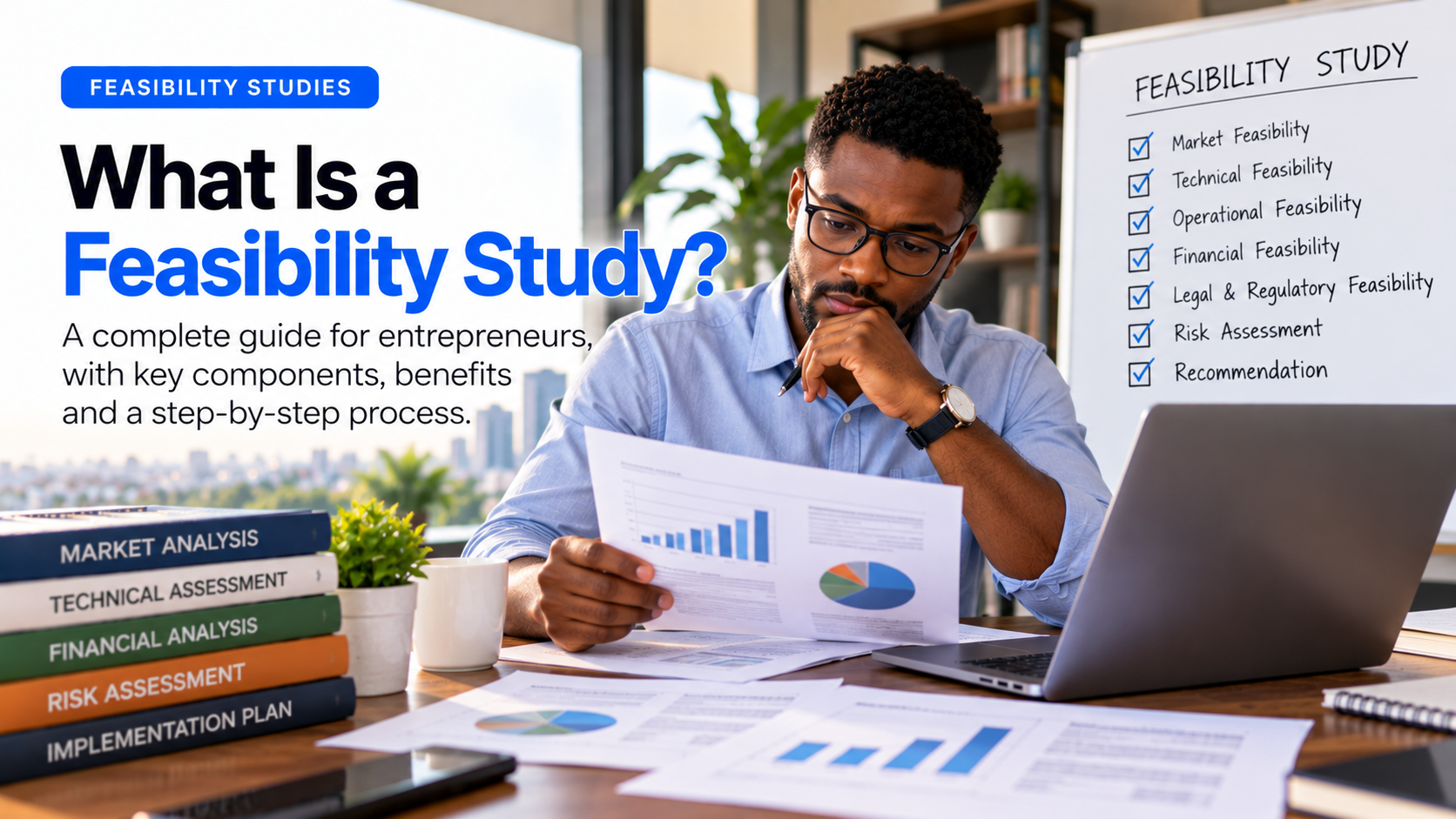
What Does a Feasibility Study Contain?
There is no single universal format. The exact structure depends on the industry, scale and purpose of the project.
However, a strong feasibility study normally examines the following areas.
1. Executive Summary
This is an overview of the entire study.
It should briefly explain:
- The business idea
- The opportunity
- Target market
- Proposed products or services
- Investment requirements
- Expected financial performance
- Major risks
- Overall feasibility conclusion
Although it appears first, it is usually easier to write it after completing the rest of the study.
2. Business or Project Description
Explain exactly what you intend to establish.
Include:
- Business concept
- Products or services
- Business model
- Proposed location
- Target customers
- Ownership structure
- Objectives
- Scope of the project
Avoid vague descriptions.
Instead of saying:
"We want to start a profitable agricultural business."
Explain exactly what you intend to produce, where, for whom, at what scale and how you expect to make money.
3. Market Feasibility
This is one of the most important sections.
A business needs customers.
Your market analysis should examine:
Target market
Who will buy your product or service?
Consider:
- Age
- Location
- Income
- Occupation
- Business type
- Buying behaviour
- Needs and preferences
Market size
How many potential customers exist?
Demand
Is there evidence that customers actually need the product?
Market trends
Is the market:
- Growing?
- Stable?
- Declining?
- Changing?
Customer behaviour
How do customers currently solve the problem?
Competition
Who else is serving the market?
Study their:
- Prices
- Products
- Distribution
- Strengths
- Weaknesses
- Customer base
- Market positioning
The goal isn't simply to say that competitors exist.
It is to understand how your business can realistically compete.
4. Technical Feasibility
Can the proposed business actually be built and operated?
This section becomes particularly important for manufacturing, agriculture, technology, construction and other capital-intensive businesses.
Consider:
- Required equipment
- Production capacity
- Technology
- Production process
- Raw materials
- Suppliers
- Utilities
- Infrastructure
- Location
- Storage
- Transportation
- Maintenance
- Technical expertise
For a manufacturing project, for example, you might need to determine:
- What machinery is required?
- Where can it be purchased?
- What is its capacity?
- How much power does it consume?
- What raw materials are required?
- Can those materials be sourced consistently?
- What production volume is realistic?
These questions can significantly change the economics of a project.
5. Operational Feasibility
A business may have a good market and good financial projections but still fail because the operation is poorly designed.
Operational feasibility examines how the business will function on a day-to-day basis.
Consider:
- Business processes
- Staffing
- Management
- Suppliers
- Inventory
- Distribution
- Customer service
- Quality control
- Procurement
- Technology
- Reporting and administration
Ask:
Can this business realistically operate at the proposed scale with the available resources?
6. Financial Feasibility
This is where the idea meets the numbers.
A financial feasibility analysis should estimate:
Startup costs
Examples include:
- Equipment
- Buildings
- Renovation
- Vehicles
- Licences
- Registration
- Initial inventory
- Installation
- Technology
- Professional fees
- Pre-launch marketing
Operating expenses
Examples include:
- Salaries
- Rent
- Utilities
- Raw materials
- Transportation
- Marketing
- Maintenance
- Insurance
- Taxes
- Administrative expenses
Revenue
Estimate how much the business could realistically sell.
Avoid simply assuming:
"If we sell 1,000 units every day, we'll make..."
The important question is:
Why do you believe you can sell 1,000 units every day?
Your sales assumptions should be connected to market evidence and realistic capacity.
Profitability
Calculate potential:
- Gross profit
- Operating profit
- Net profit
Cash flow
A profitable business can still fail if it runs out of cash.
Therefore, cash-flow analysis is essential.
7. Legal and Regulatory Feasibility
Some businesses require specific licences, permits, registrations or regulatory approvals.
Depending on the industry and country, investigate:
- Business registration
- Industry licences
- Product approvals
- Environmental requirements
- Tax obligations
- Employment regulations
- Health and safety
- Import/export requirements
- Land-use requirements
- Industry-specific regulations
A business idea may be commercially attractive but legally difficult or expensive to operate.
8. Risk Analysis
No feasibility study is complete without examining what could go wrong.
Create a risk register covering areas such as:
| Risk | Potential Impact | Likelihood | Mitigation |
|---|---|---|---|
| Raw material price increases | High | Medium | Multiple suppliers |
| Weak initial demand | High | Medium | Pilot launch |
| Equipment failure | High | Low | Maintenance + backup |
| Strong competition | Medium | High | Differentiation |
| Cash-flow shortage | High | Medium | Working-capital reserve |
The purpose isn't to make the project look risk-free.
It is to determine whether the risks are understood and manageable.
9. SWOT Analysis
A feasibility study can also use a SWOT analysis:
- Strengths — What advantages does the business have?
- Weaknesses — Where is it vulnerable?
- Opportunities — What external opportunities exist?
- Threats — What external factors could hurt it?
SWOT shouldn't replace detailed analysis, but it can be useful for summarising the strategic position.
10. Feasibility Conclusion
The final section brings everything together.
Your conclusion should answer:
Is the business feasible?
And more importantly:
Under what conditions is it feasible?
For example:
"The proposed business appears commercially and financially feasible, provided the project secures sufficient working capital, maintains the projected gross margin, and establishes reliable raw-material supply."
That is much more useful than simply saying:
"The business is profitable."
How to Conduct a Feasibility Study
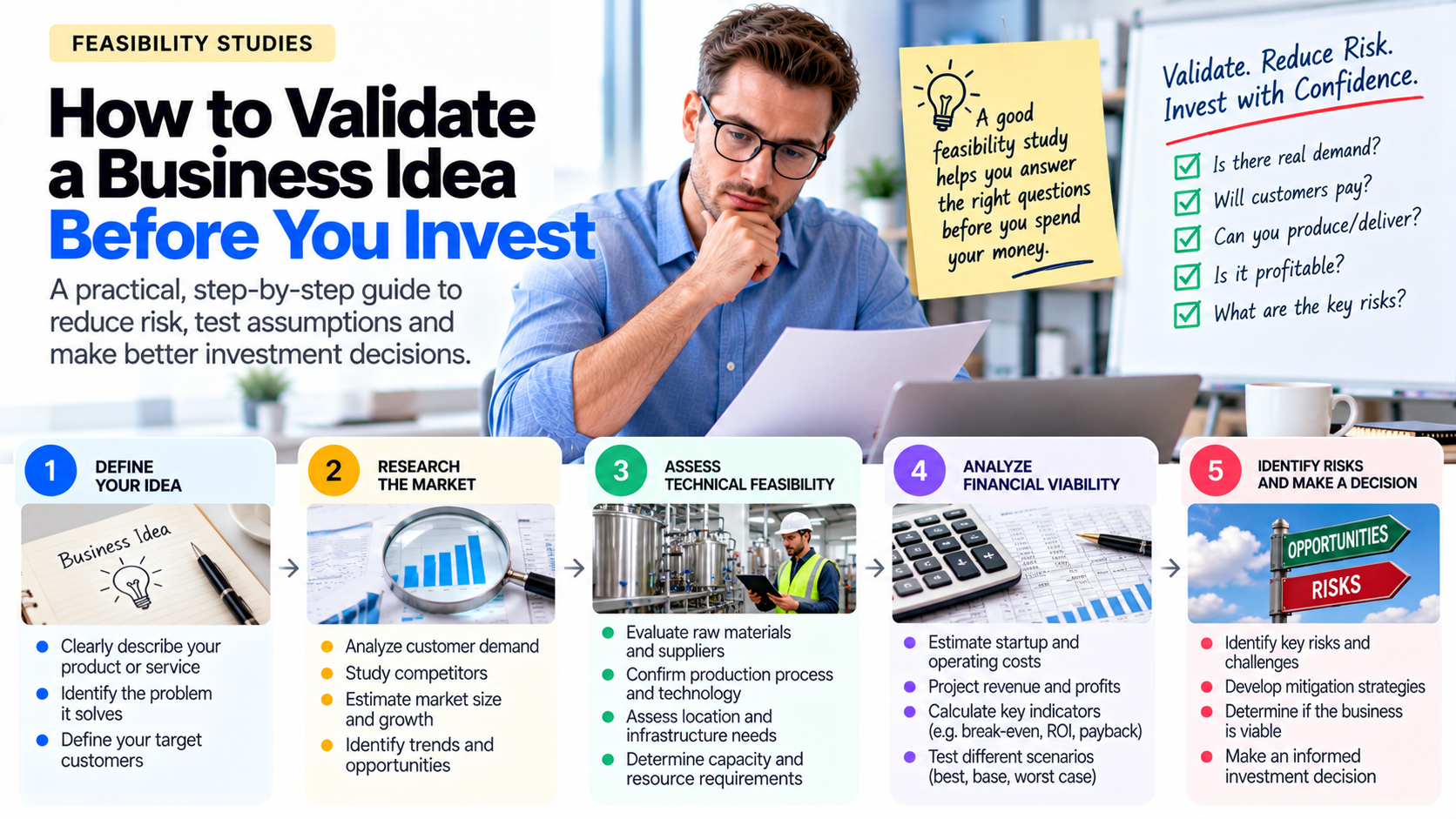
A practical process looks like this:
Step 1: Define the business idea
Clearly describe what you want to build.
Step 2: Identify the problem and customer
Determine who has the problem your business intends to solve.
Step 3: Research the market
Study demand, customers, competitors, market size and trends.
Step 4: Define your business model
Determine exactly how the business will make money.
Step 5: Determine operational requirements
Identify people, equipment, technology, suppliers, facilities and processes.
Step 6: Estimate startup costs
Calculate the investment required before the business can begin operating.
Step 7: Build financial projections
Estimate revenue, expenses, profit, cash flow and investment returns.
Step 8: Identify risks
Determine what could prevent the business from succeeding.
Step 9: Test your assumptions
Challenge the numbers.
What happens if:
- Sales are 30% lower?
- Costs increase by 20%?
- Launch is delayed?
- Customers pay more slowly?
- Equipment costs more than expected?
Step 10: Make the decision
Based on the evidence, decide whether to:
Proceed, modify the idea, conduct further research, or stop.
Common Mistakes Entrepreneurs Make
1. Starting with the financial projections
Numbers are important, but they shouldn't be invented to make an idea look profitable.
Start with the market and operating reality.
2. Overestimating sales
This is one of the most common mistakes.
Having the capacity to produce 10,000 units doesn't mean you can sell 10,000 units.
3. Underestimating costs
Entrepreneurs often calculate equipment and rent but forget working capital, marketing, logistics, maintenance and unexpected expenses.
4. Ignoring competitors
Having competitors doesn't automatically mean your business won't work.
But pretending they don't exist is dangerous.
5. Using outdated information
Market prices, regulations, customer behaviour and competitive conditions can change.
Use current information wherever possible.
6. Treating assumptions as facts
Clearly distinguish between:
- Known information
- Estimated information
- Assumptions
This makes the study much more credible.
7. Writing what you want to hear
The purpose of a feasibility study isn't to justify your decision.
It is to improve your decision.
If the evidence says the project doesn't make sense, that's a successful outcome of the study.
How Much Does a Feasibility Study Cost?
The cost depends heavily on the complexity of the project.
A small entrepreneur researching a simple service business may be able to conduct much of the analysis independently.
A large manufacturing, agricultural, real estate, energy or infrastructure project may require:
- Market researchers
- Engineers
- Financial analysts
- Industry specialists
- Legal advisers
- Environmental consultants
- Technical consultants
The more capital you are putting at risk, the more rigorous your feasibility analysis should be.
When Should You Conduct a Feasibility Study?
Consider conducting one when:
- You are starting a new business.
- You are introducing a new product.
- You are entering a new market.
- You are considering a major investment.
- You are expanding production.
- You are opening a new location.
- You are seeking substantial funding.
- You are unsure whether an idea is commercially viable.
For small, low-cost ideas, a full formal study may be unnecessary.
But the thinking behind a feasibility study is valuable for almost every business decision.
A Simple Feasibility Checklist
Before committing significant money to a business idea, make sure you can answer:
Market
- Who is the customer?
- What problem are they solving?
- How large is the market?
- Is there evidence of demand?
- Who are the competitors?
Product
- What exactly are you selling?
- Why will customers choose it?
- What makes your offering competitive?
Operations
- Where will the business operate?
- What equipment and resources are required?
- Who will run it?
- Who are the suppliers?
Financials
- How much will it cost to start?
- How much working capital is required?
- What will it cost to operate?
- How much can you realistically sell?
- What will the margins be?
- When could the business become profitable?
Risk
- What could go wrong?
- Which assumptions are most uncertain?
- How could those risks be reduced?
Decision
- Is the opportunity worth pursuing?
- What needs to change before proceeding?
- What evidence is still missing?
If you cannot answer these questions, you probably aren't ready to make a major investment decision.
Final Thoughts
A business idea can be exciting.
But excitement isn't evidence.
Before committing significant resources, entrepreneurs need to understand the market, customers, competition, operations, financial requirements and risks surrounding the opportunity.
That's what a feasibility study is designed to do.
The goal isn't to create a document that says your idea will succeed.
The goal is to discover whether the idea deserves your money, time and attention.
And sometimes, the most valuable conclusion a feasibility study can produce is:
"Don't do this."
That conclusion can save an entrepreneur years of effort and significant financial loss.
For entrepreneurs who want to turn their business idea into a structured feasibility analysis, LoDuko guides you through the questions that matter and transforms your answers into a professional feasibility report.
One guided interview. Better business intelligence. Better decisions.
Start with LoDuko →