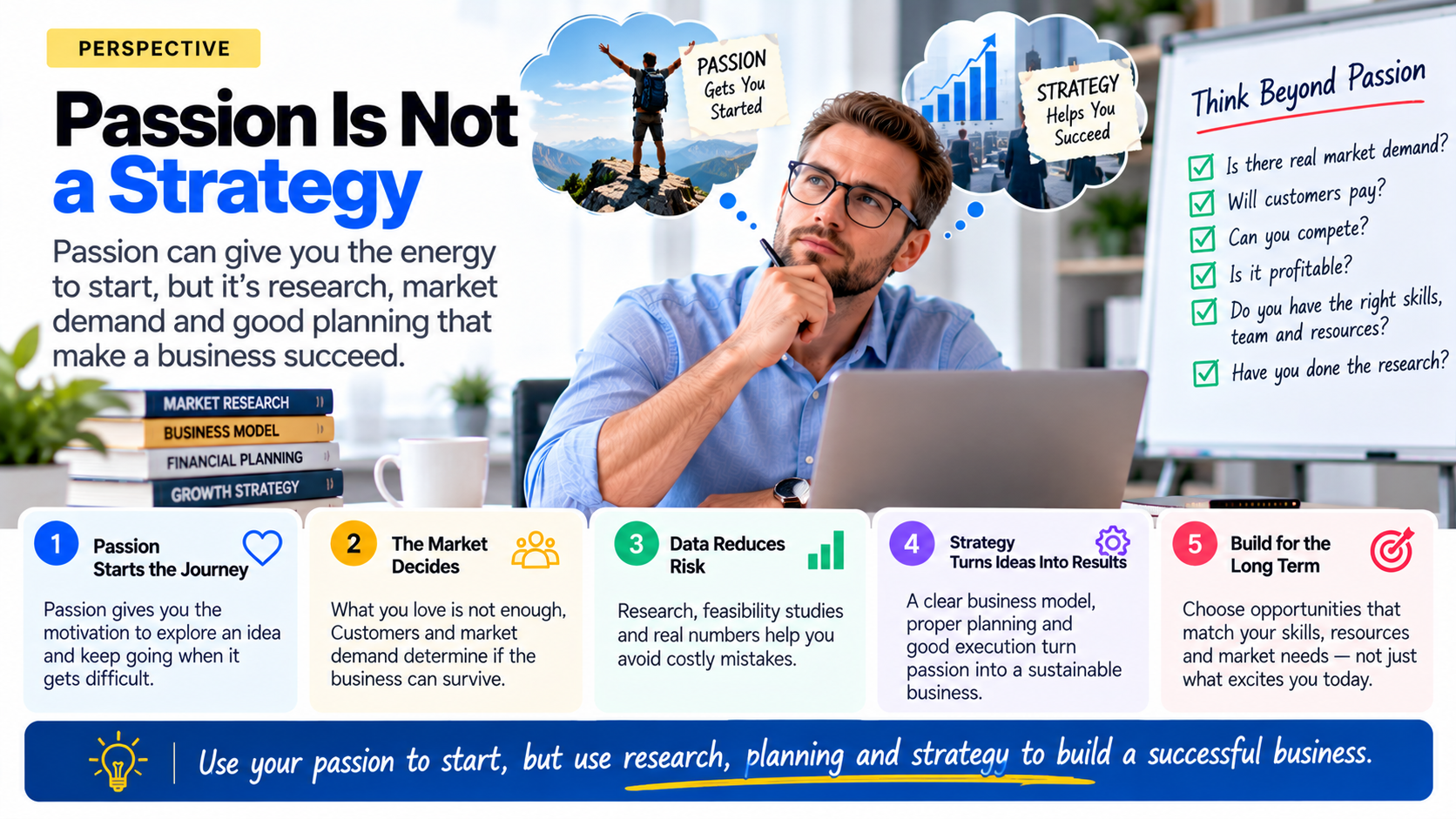
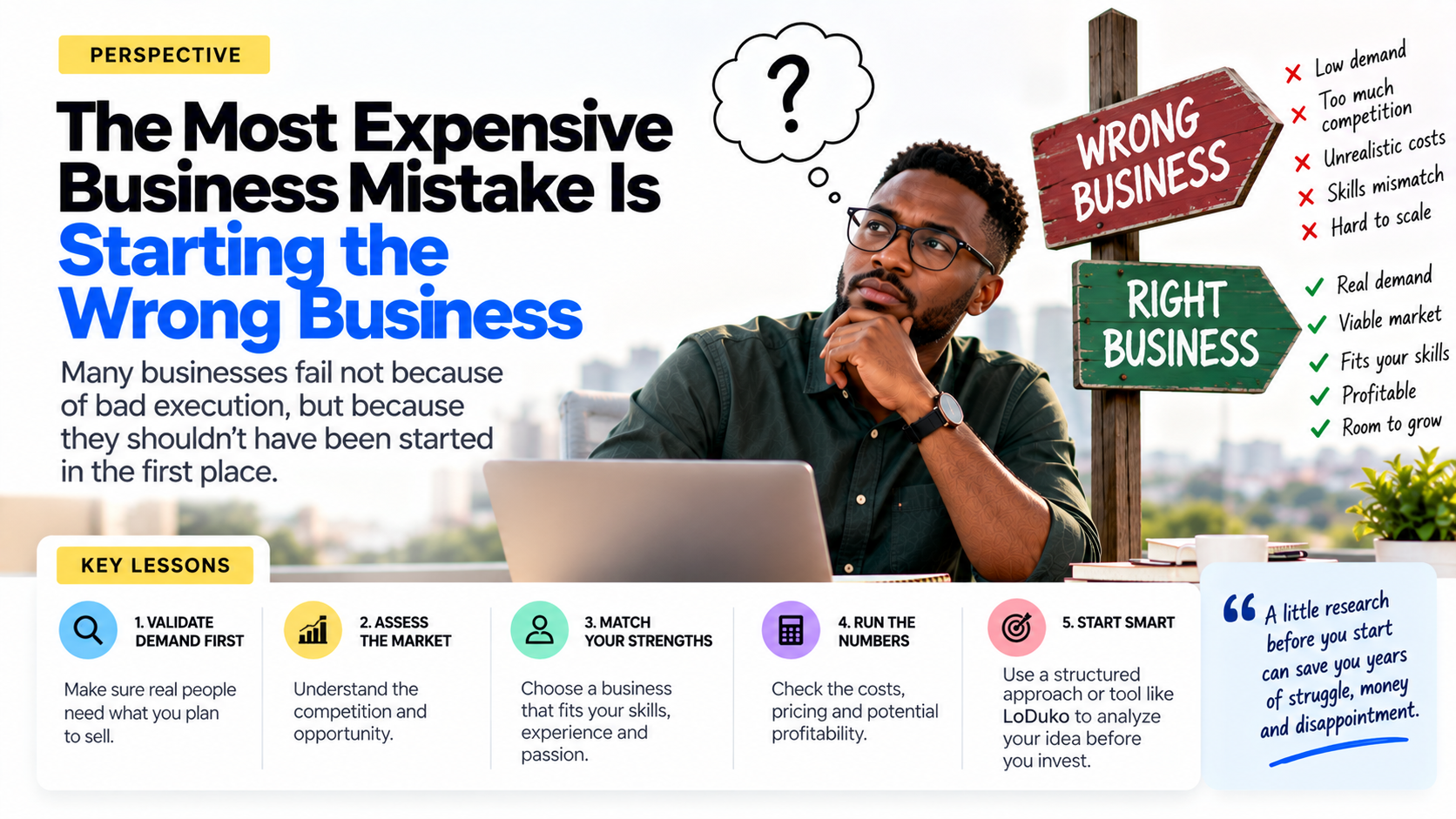
The Most Expensive Business Mistake Is Starting the Wrong Business
Why entrepreneurs should spend more time validating a business opportunity before spending money building it.
There are many expensive mistakes in entrepreneurship.
Hiring the wrong employee.
Choosing the wrong supplier.
Overspending on equipment.
Running out of cash.
Launching a poorly designed product.
But one mistake can make many of the others almost inevitable:
Starting a business that should never have been started in the first place.
This doesn't mean the entrepreneur is incapable.
It doesn't mean the product is necessarily bad.
And it doesn't mean the business cannot eventually succeed.
It means the entrepreneur committed significant time, money and energy before establishing that the opportunity was sufficiently attractive and achievable.
That is one of the most avoidable mistakes in entrepreneurship.
The Problem With Falling in Love With an Idea
Entrepreneurs often fall in love with ideas.
They imagine:
The product
The factory
The office
The website
The brand
The customers
The revenue
The expansion
They start thinking about execution before answering the more fundamental question:
Should this business exist?
This is where emotional attachment can become dangerous.
Once an entrepreneur has spent money on equipment, branding, inventory or a location, it becomes psychologically harder to admit that the original assumption may have been wrong.
The business starts controlling the entrepreneur instead of the entrepreneur controlling the business.
An Idea Is Not a Business
Consider this statement:
"I want to start a premium healthy snack company."
That's an idea.
A business requires much more.
You need to know:
Who will buy it?
Why will they buy it?
How often?
What will they pay?
Who are the competitors?
What will it cost to produce?
How will customers find it?
How will you distribute it?
How much capital is required?
What could prevent it from working?
Can you make an attractive return?
Until these questions have credible answers, you're still developing an idea.
The Most Dangerous Sentence in Entrepreneurship
One of the most dangerous sentences an entrepreneur can say is:
"People will definitely buy it."
Maybe they will.
But what evidence supports that belief?
Have they:
Bought something similar?
Asked for the product?
Agreed to pay?
Placed an order?
Signed a contract?
Participated in a pilot?
Repeatedly used the product?
There is a huge difference between:
"People like the idea."
and
"People will pay for the solution."
Entrepreneurs should care much more about the second.
Validation Is Not Pessimism
Some entrepreneurs believe that questioning an idea means lacking confidence.
The opposite is true.
Validation is disciplined optimism.
You are saying:
"I believe this opportunity may work, so I want to test the assumptions before risking significant capital."
That is intelligent entrepreneurship.
The Five Questions Every Entrepreneur Should Answer
Before committing substantial resources, ask five questions.
1. Is there a real problem?
Does the customer actually experience the problem?
How frequently?
How painful is it?
What does the problem currently cost them?
2. Is there a real customer?
Who specifically has the problem?
"Everyone" is usually not a useful target market.
Define the customer clearly enough that you could identify them.
3. Is there willingness to pay?
A problem can be real without being commercially attractive.
People may complain about something without being willing to spend money to solve it.
You need evidence of purchasing behaviour or credible willingness to pay.
4. Can you make money solving it?
Revenue is not enough.
You need to understand:
Selling price − variable cost = contribution
Then consider:
Fixed costs
Customer acquisition
Distribution
Working capital
Taxes
Financing
Other operating expenses
A product can be popular and still be a bad business.
5. Can you realistically win?
A market can be attractive and still be the wrong opportunity for you.
Ask:
Do you have relevant capabilities?
Can you access customers?
Can you raise the required capital?
Can you build the product?
Can you compete?
Do you have distribution?
Do you understand the market?
Opportunity matters.
Founder-market fit matters too.
The "Wrong Business" Doesn't Always Mean a Bad Business
This distinction is important.
A business can be objectively good and still be wrong for you.
For example, suppose a market is growing rapidly but requires:
$2 million of capital
Specialized technical expertise
Complex regulatory approvals
Long development cycles
It may be an excellent opportunity for the right team.
It may be a terrible opportunity for an entrepreneur with limited capital and no industry experience.
The question isn't:
"Is this a good business?"
It is:
"Is this a good business for us, in this market, under these conditions?"
The Cost of Being Wrong
Starting a business consumes more than money.
Consider the full cost.
Financial cost
Startup capital
Inventory
Equipment
Rent
Marketing
Professional fees
Time cost
Months or years can be invested in an unsuccessful business.
Opportunity cost
The entrepreneur could have pursued another opportunity.
Emotional cost
Failure can create stress, frustration and loss of confidence.
Relationship cost
Financial pressure can affect families, partners and employees.
This is why validation matters.
It isn't about avoiding all risk.
It is about avoiding unnecessary risk.
The Founder Trap: Sunk Costs
Suppose an entrepreneur invests $100,000 in a business.
Six months later, the evidence suggests demand is much weaker than expected.
The entrepreneur thinks:
"I've already invested $100,000. I can't quit now."
But the $100,000 is already gone.
The better question is:
"If I had not invested anything yet, would I invest $100,000 in this business today based on what I now know?"
If the answer is no, the entrepreneur needs to seriously reconsider the strategy.
Past spending should not automatically determine future decisions.
Start Small Before You Scale
One of the strongest ways to reduce risk is to test the business at a smaller scale.
Instead of:
Idea → Factory
consider:
Idea → Prototype → Test → Customers → Repeat Sales → Small-Scale Operation → Expansion
Instead of spending $500,000 immediately, perhaps you can test some assumptions with $5,000.
Instead of building a full software platform, perhaps you can test the service manually.
Instead of opening ten locations, test one.
Instead of manufacturing 100,000 units, test a smaller production run.
The objective is not to build a tiny version forever.
It is to learn before committing heavily.
The Minimum Viable Business
The concept of a Minimum Viable Product is widely discussed in technology.
The same thinking can apply to almost any business.
Ask:
What is the smallest version of this business that can test the most important assumptions?
For a food business, it might be a small production batch.
For a consulting business, it might be a paid pilot.
For an online service, it might be a simple landing page and manual service.
For a manufacturing idea, it might be outsourced production.
For a marketplace, it might be manually matching buyers and sellers.
The goal is learning—not appearance.
Don't Validate Everything at Once
Not every assumption has equal importance.
Identify the critical assumptions.
For example:
Business idea
"We believe customers need this product."
Pricing
"We believe customers will pay $30."
Distribution
"We believe retailers will carry it."
Production
"We believe we can produce it at $12 per unit."
Acquisition
"We believe we can acquire customers for $8."
If one of these assumptions is fundamentally wrong, the business model may fail.
Test those assumptions first.
The Most Important Number May Not Be Revenue
Entrepreneurs often ask:
"How much revenue can this business make?"
A better question may be:
"How much profit can we generate from each customer, and how efficiently can we acquire them?"
Consider two businesses.
Business A
Revenue per customer: $100
Gross profit: $30
Customer acquisition cost: $25
Business B
Revenue per customer: $100
Gross profit: $60
Customer acquisition cost: $15
The businesses have identical revenue per customer.
Their economics are completely different.
Understanding unit economics early can prevent enormous mistakes later.
Growth Can Hide a Bad Business
High revenue growth can look impressive.
But growth can also consume enormous amounts of cash.
Imagine a business that grows from:
$100,000 → $300,000 → $1 million in annual revenue
That sounds excellent.
But suppose every additional dollar of revenue requires heavy discounts, expensive marketing and additional working capital.
The company may be growing while becoming financially weaker.
Growth is valuable when it creates economic value.
The Business Model Must Make Sense
A business model explains how the company creates, delivers and captures value.
At minimum, understand:
Customer
Who pays?
Value proposition
Why do they pay?
Revenue
How does money come in?
Costs
What does it cost to deliver?
Distribution
How do you reach customers?
Operations
What must happen behind the scenes?
Advantage
Why can competitors not easily take the opportunity?
If these pieces don't fit together, more marketing won't necessarily save the business.
Competition Is Evidence
Competition is not always bad.
In many cases, existing competitors demonstrate that:
Customers exist.
Money is being spent.
The problem is real.
A market already exists.
The real questions are:
Why would customers choose you?
and:
Can you compete profitably?
"No competition" can sometimes be a warning rather than an advantage.
Don't Build for Yourself Alone
Entrepreneurs naturally understand their own problems.
But your experience doesn't automatically represent the market.
You might love a product that nobody else wants.
Before investing heavily, talk to potential customers.
Ask about:
Their current behaviour
Their problems
Existing solutions
What they dislike
What they pay today
What would make them switch
Most importantly, observe what they do, not only what they say.
The Business Plan Should Challenge You
A business plan shouldn't be a document designed to prove that your idea will succeed.
It should be a structured argument that allows you to ask:
"What would have to be true for this business to work?"
That's a much more powerful question.
Your assumptions should be visible.
Your risks should be visible.
Your economics should be visible.
Your weaknesses should be visible.
Then you can decide what needs to be tested.
The Feasibility Study As a Decision Tool
A feasibility study is particularly valuable before major investment.
It can examine:
Market feasibility
Customer demand
Competition
Technical requirements
Operations
Financial viability
Regulatory considerations
Risks
Investment requirements
Its purpose isn't to guarantee success.
Its purpose is to help answer:
"Does this opportunity appear viable enough to justify moving forward?"
That can be an extremely valuable question to answer before spending significant money.
Three Possible Outcomes of Validation
Validation doesn't always produce a "yes."
It can produce three valuable outcomes.
1. Proceed
The evidence supports the business.
2. Modify
The original idea has potential, but something needs to change.
Perhaps:
Customer segment
Pricing
Product
Distribution
Business model
3. Stop
The evidence suggests the opportunity is not attractive enough.
Stopping can be a success.
If you spend $2,000 to discover that you should not spend $200,000, you didn't waste $2,000.
You potentially saved $198,000.
The Most Valuable Question: "What Would Make Us Wrong?"
Entrepreneurs naturally search for evidence supporting their idea.
Try doing the opposite.
Ask:
What evidence would convince us that this business will not work?
Maybe:
Customers refuse to pay the required price.
Production costs are too high.
Customer acquisition is too expensive.
Competitors are too strong.
Regulations make the model impractical.
Working-capital requirements are too large.
Demand is seasonal.
The market is smaller than expected.
Finding these issues early is valuable.
A Better Entrepreneurial Sequence
Instead of:
Idea → Money → Product → Marketing → Hope
consider:
Problem → Customer → Market → Solution → Validation → Economics → Business Model → Small Test → Evidence → Investment → Scale
This sequence doesn't eliminate risk.
It improves the quality of your decisions.
What LoDuko Believes
This is where LoDuko's philosophy begins.
We believe entrepreneurs shouldn't have to choose between:
"Just trust your idea."
and
"Spend months creating a complicated business plan."
There is a better approach.
Start with the business.
Ask the important questions.
Structure the information.
Identify assumptions.
Evaluate the opportunity.
Then turn that thinking into useful business documents.
The document is not the destination.
Better decisions are.
Answer Once. Build From There.
This philosophy is central to LoDuko.
A founder shouldn't have to repeatedly explain the same business from scratch.
Through a guided business interview, entrepreneurs can structure the information behind their business idea.
That information can then support different outputs:
Feasibility Report
→ Should we pursue this opportunity?
Business Plan
→ How will we build and operate it?
Pitch Deck
→ How do we communicate the opportunity?
One structured foundation.
Multiple business outputs.
Answer once. Build from there.
The LoDuko Perspective
We believe the future of business planning should be less about filling templates and more about thinking clearly.
Less:
"How do I make my business plan look professional?"
More:
"Do I actually understand my business?"
Less:
"How can I convince investors?"
More:
"What evidence supports this opportunity?"
Less:
"How quickly can I launch?"
More:
"What should I validate before I launch?"
Less:
"How much money can I raise?"
More:
"How much capital does this business actually need, and what will it accomplish?"
This is the difference between document creation and business intelligence.
The Five Decisions Before You Spend Serious Money
Before committing significant capital, make sure you can answer:
1. Who is the customer?
Be specific.
2. What problem are you solving?
Make it concrete.
3. Why will customers choose you?
Identify your real advantage.
4. Can the economics work?
Understand revenue, costs, margins, cash flow and capital requirements.
5. What evidence supports the assumptions?
Separate facts from guesses.
If you cannot answer these questions, the next step may not be launching.
It may be learning.
Final Thoughts
Entrepreneurship requires courage.
But courage without analysis can become recklessness.
The goal isn't to eliminate uncertainty.
You can't.
The goal is to reduce uncertainty before the cost of being wrong becomes too high.
Your first idea doesn't have to be perfect.
Your first business model doesn't have to be final.
Your first strategy doesn't have to survive unchanged.
But you should build a habit of asking better questions before making bigger commitments.
Because sometimes the smartest entrepreneurial decision is not:
"Let's build it."
It is:
"Let's find out whether it deserves to be built."
The most expensive business mistake may not be failing after starting the right business.
It may be spending years building the wrong one.
Plan. Validate. Launch. With confidence.
Explore LoDuko at loduko.com.